
Level 5/6
CogAT® guide for parents · Grades K-5
Get your child ready for the CogAT test
The CogAT (Cognitive Abilities Test) is how most schools find gifted students. Practice free with a test for every grade, K to 5th, with every answer explained.
- 54 free questions with answers
- 6 printable PDFs
- Updated for 2026-27

Practice profile2nd grade
Free CogAT practice tests by grade
Each test has 9 questions, one for every CogAT question type, with instant feedback and an explanation for every answer. Prefer paper? Every grade has a printable PDF of the same test.
Try these CogAT sample questions
Three of the most important CogAT question types, from our 1st grade and 2nd grade practice tests. Read each question aloud and let your child tap an answer.
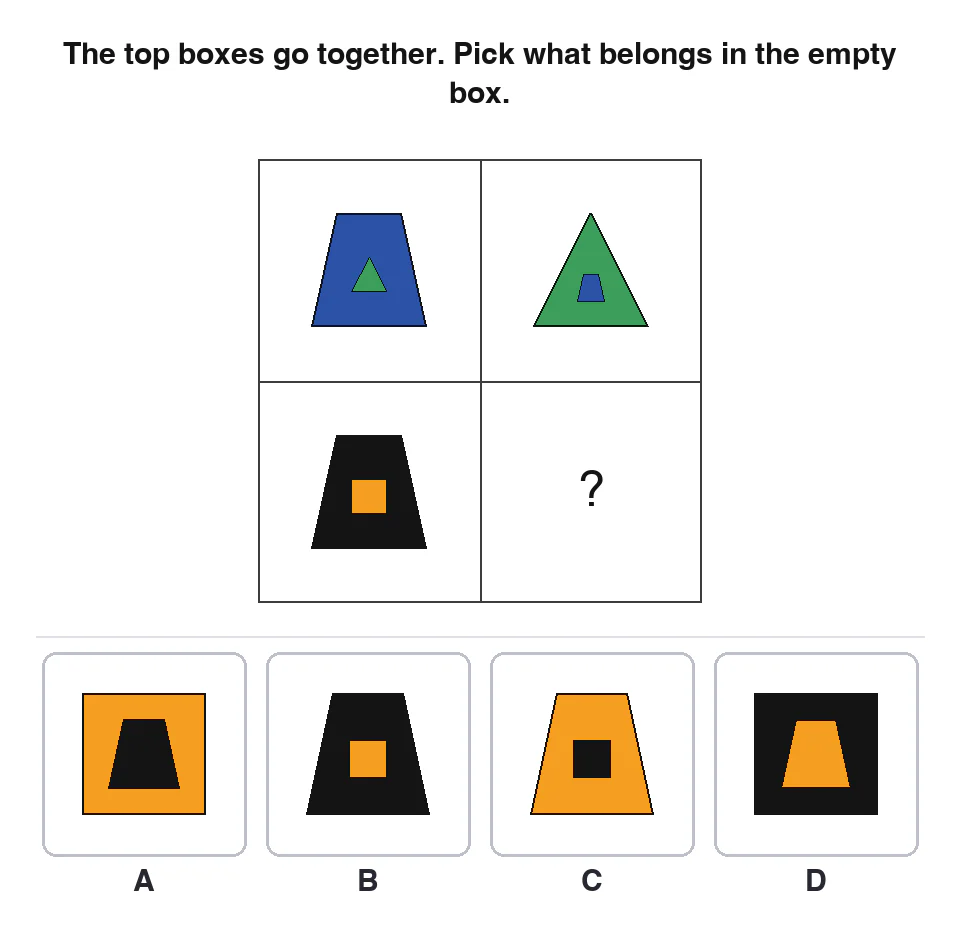
The top boxes go together. Pick what belongs in the empty box.
Show answer
Answer: A. The inside and outside shapes trade places, and each keeps its color. The orange square goes outside, the black trapezoid inside.
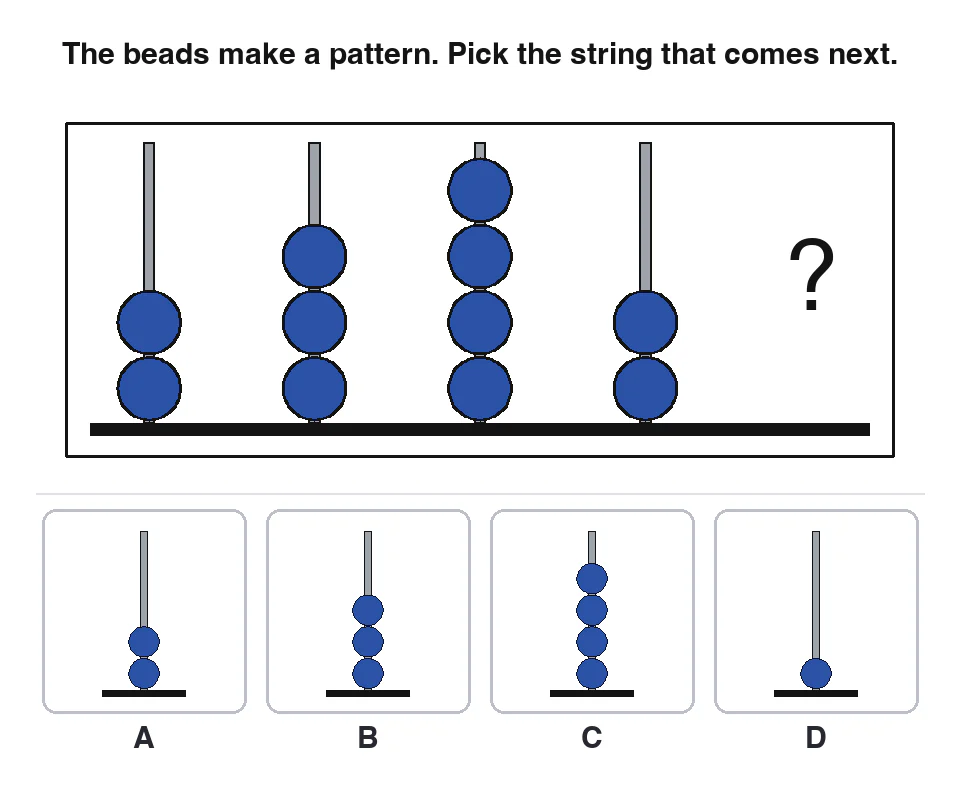
The beads make a pattern. Pick the string that comes next.
Show answer
Answer: B (3 beads). The counts repeat 2, 3, 4. After 2 comes 3.
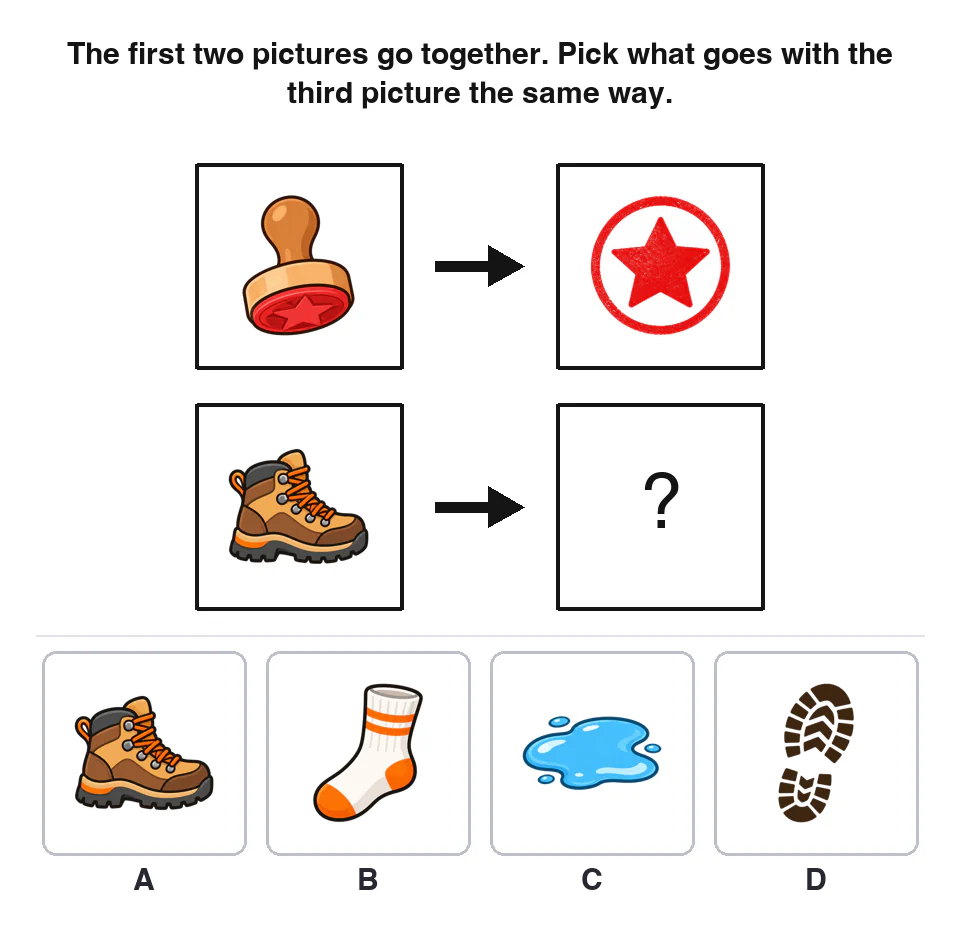
The first two pictures go together. Pick what goes with the third picture the same way.
Show answer
Answer: D (footprint). A rubber stamp leaves a stamped star. A boot leaves a boot print.
What is the CogAT test?
The CogAT (Cognitive Abilities Test) is the reasoning test most US schools use to identify gifted and talented students, from kindergarten through 12th grade.
The CogAT test measures how well a child reasons and solves problems using words, numbers and shapes. Unlike a state achievement test, it is not about what was taught in class this year. It looks at the thinking skills that help children learn new things: spotting relationships, finding patterns, and working out rules.
The test is published by Riverside Insights and written by Dr. David Lohman. Schools give it to whole classes or grades at once, on paper or online, to students from kindergarten through 12th grade. The most common reason your child is taking the CogAT is gifted and talented identification: many districts screen every student in a particular grade (often 2nd) and invite the top scorers into an advanced program.
The current editions are Form 7 and Form 8, which are parallel versions of the same test. Schools may give the full test (nine subtests) or the shorter Screening Form (three subtests). Read the full guide to the CogAT

The three CogAT batteries
Every level of the CogAT test has three parts, called batteries, with three subtests each. Together they give a composite score and a profile of your child's reasoning strengths.
Battery 1
Verbal
Reasoning with words and concepts. At K-2 everything is pictures and read aloud.
Battery 2
Quantitative
Reasoning with numbers and quantities, not school math facts.
Battery 3
Nonverbal
Reasoning with shapes and figures. No reading or language needed.
CogAT levels by grade
The CogAT has a different level for each grade. The level, not the grade, decides which version of the test your child takes. Levels 5/6 to 8 are picture-based and read aloud; from Level 9 students read on their own.
| Grade | CogAT level | Format | Practice test |
|---|---|---|---|
| Kindergarten | Level 5/6 | Pictures, read aloud | Kindergarten test |
| 1st grade | Level 7 | Pictures, read aloud | 1st grade test |
| 2nd grade | Level 8 | Pictures, read aloud | 2nd grade test |
| 3rd grade | Level 9 | Reads independently, 10 min per subtest | 3rd grade test |
| 4th grade | Level 10 | Reads independently, 10 min per subtest | 4th grade test |
| 5th grade | Level 11 | Reads independently, 10 min per subtest | 5th grade test |
| 6th grade | Level 12 | Reads independently | Coming soon |
| 7th-12th grade | Levels 13/14 to 17/18 | Reads independently | Coming soon |
How CogAT scores work
Your child's raw score (the number correct) is converted into scores that compare them with other students of the same age and the same grade. The three you will see most are:
| Score | What it means | Range |
|---|---|---|
| Standard Age Score (SAS) | Compares your child with students of the same age. Average is 100. | 50 to 160 |
| Percentile Rank (PR) | The percent of students your child scored the same as or higher than. | 1 to 99 |
| Stanine | A simple 9-point band. 5 is average; 9 is the top 4 percent. | 1 to 9 |
Gifted programs usually look at the composite score (all three batteries) and often require a percentile rank of 95 to 98 or higher, depending on the district. CogAT scores explained, with a full SAS to percentile chart
How to prepare for the CogAT test
- Learn the question types. Unfamiliar formats cost more points than hard questions. Walk through each of the CogAT question types once.
- Practice a little, often. 10 to 15 minutes a day for a few weeks beats a long session the night before.
- Talk through the "why". Ask your child to explain their answer. Explaining builds the reasoning the test measures.
- Practice listening (K-2) or pacing (3rd grade up). Primary levels are read aloud; Level 9 and up have 10-minute limits per subtest.
- Keep it low-pressure. A calm, rested child does better than a drilled, anxious one.

CogAT test FAQ
What is the CogAT test?
The CogAT (Cognitive Abilities Test) is a group-administered reasoning test published by Riverside Insights. It measures verbal, quantitative and nonverbal reasoning in students from kindergarten through 12th grade, and schools use it most often to identify students for gifted and talented programs.
What grade is the CogAT given in?
It can be given in any grade from K to 12, but it is most common in kindergarten through 3rd grade, when many districts screen for gifted programs. Second grade is the single most common year because of universal screening.
Is the CogAT an IQ test?
Not exactly. It measures reasoning abilities that are closely related to what IQ tests measure, and its Standard Age Score uses a similar scale (average 100). But it is a group test given at school, it is not a clinical IQ assessment, and it does not report an IQ.
How long is the CogAT test?
At Level 9 and above (3rd grade up), each of the nine subtests is timed at 10 minutes, about 90 minutes of testing in total, usually spread over several sessions. Levels 5/6 to 8 are paced by the teacher. The Screening Form uses only three subtests.
What is a good CogAT score?
A Standard Age Score of 100 is exactly average (50th percentile). Scores of 120 and above are in the top 11 percent, and many gifted programs look for scores around the 95th to 98th percentile, roughly SAS 126 to 132 or higher.
Can you study for the CogAT?
You cannot memorize answers, but practice helps. Children who know what each question type looks like are calmer, waste less time figuring out instructions, and are more likely to show their real ability. Short, regular practice works better than cramming.
Is the CogAT given on paper or a computer?
Both. Schools can give the CogAT on paper or online. At the primary levels the questions are read aloud by the teacher or by recorded audio online.
Are these the real CogAT questions?
No. Real CogAT items are secure. Every practice question on this site is original and written to match the format and difficulty of each CogAT subtest and level.
See all CogAT questions and answers

Long-time gifted test researcher with graduate study in cognitive science, reasoning and intelligence. Former gifted program student (99.9th percentile).