
 By
Free CogAT practice test
5th Grade CogAT Practice Test · Level 11
- Nonverbal
- Quantitative
- Verbal
Tip for parents: let your child read each question on their own, just as they will on test day.
Nonverbal Battery
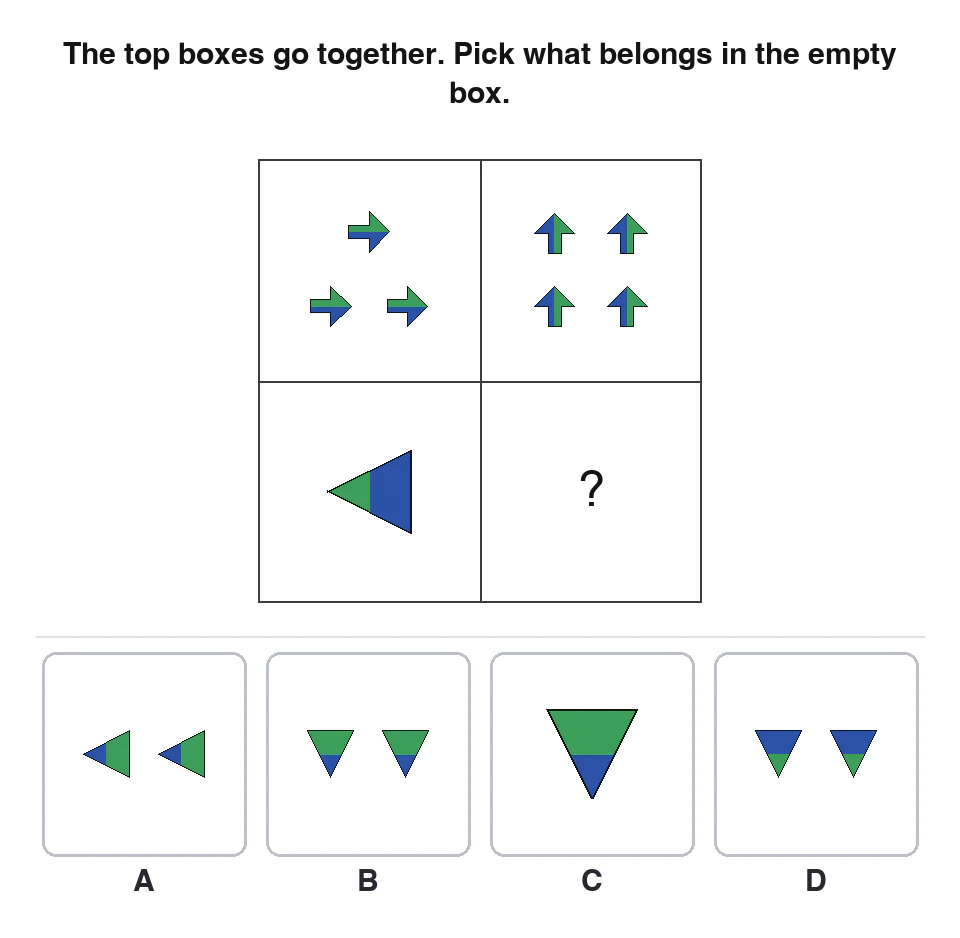
The top boxes go together. Pick what belongs in the empty box.
Show answer
Answer: B. Three changes at once: a quarter turn counterclockwise, the shading flips, and one more shape. Apply all three to the triangle.
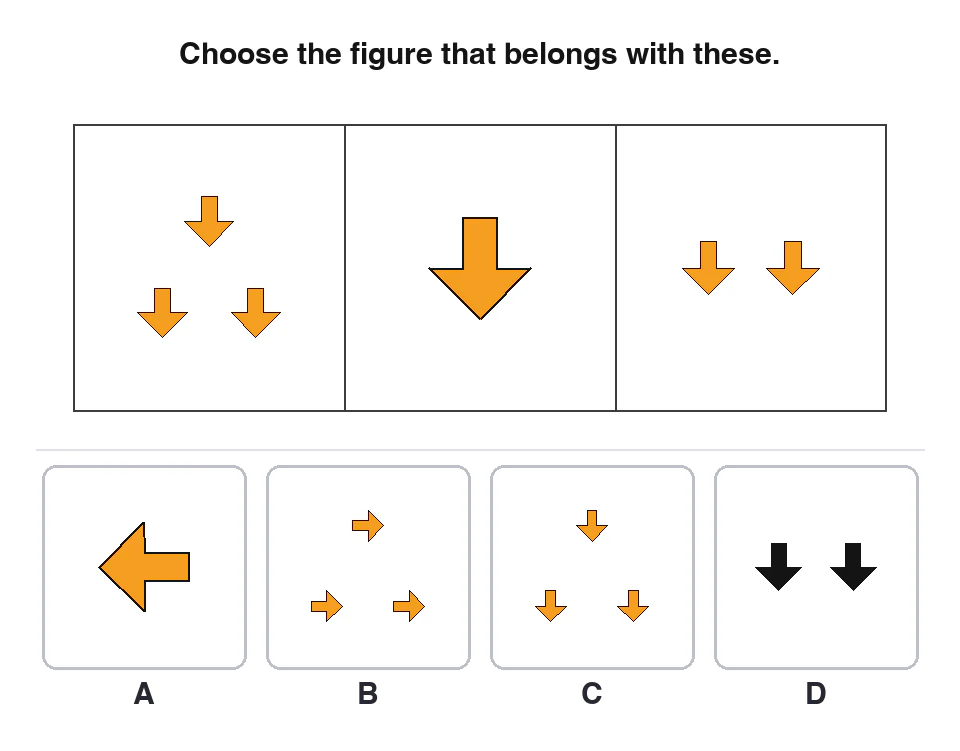
Choose the figure that belongs with these.
Show answer
Answer: C (orange down arrows). Every box has orange arrows pointing down. Only C matches both color and direction.
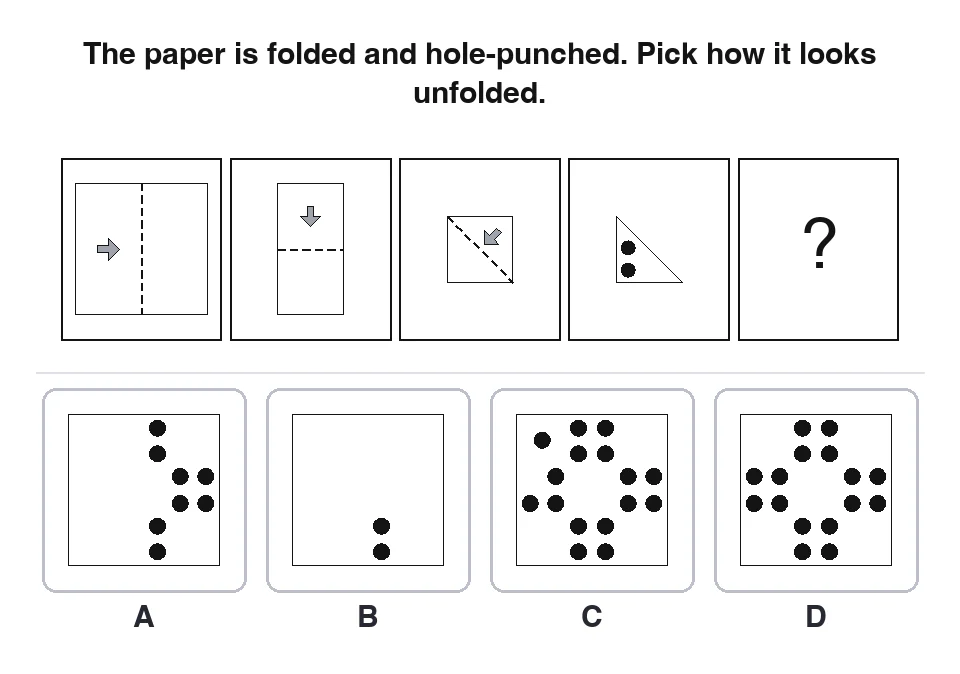
The paper is folded and hole-punched. Pick how it looks unfolded.
Show answer
Answer: D (16 holes in a symmetric pattern). Three folds make 8 layers, so the 2 punched holes become 16, mirrored back across each fold.
Quantitative Battery
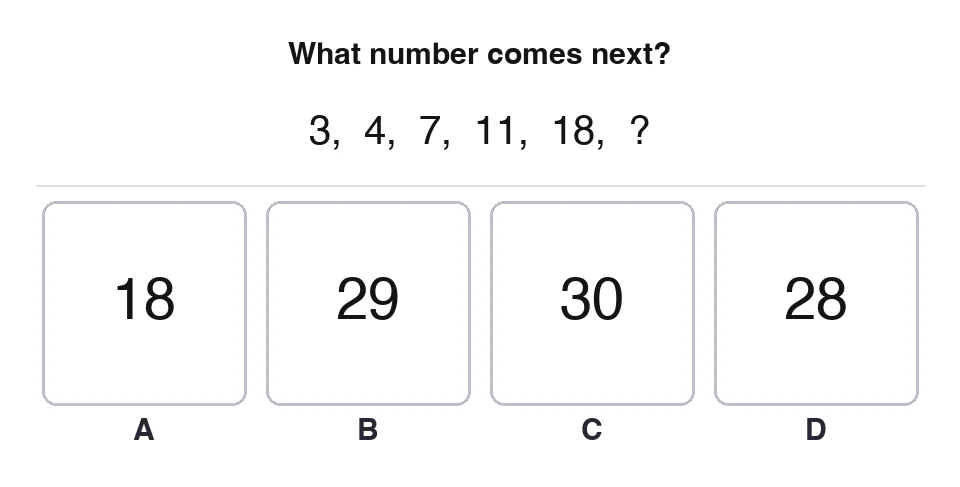
What number comes next?
3, 4, 7, 11, 18, ?
Show answer
Answer: B (29). Each number is the sum of the two before it: 11 + 18 = 29.
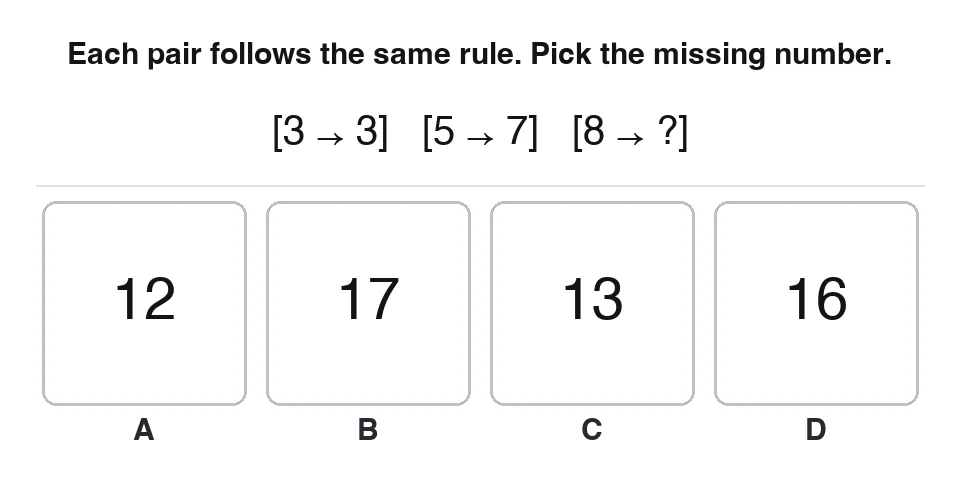
Each pair follows the same rule. Pick the missing number.
[3 → 3] [5 → 7] [8 → ?]
Show answer
Answer: C (13). Double, then subtract 3: 3 to 3, 5 to 7, so 8 to 13.
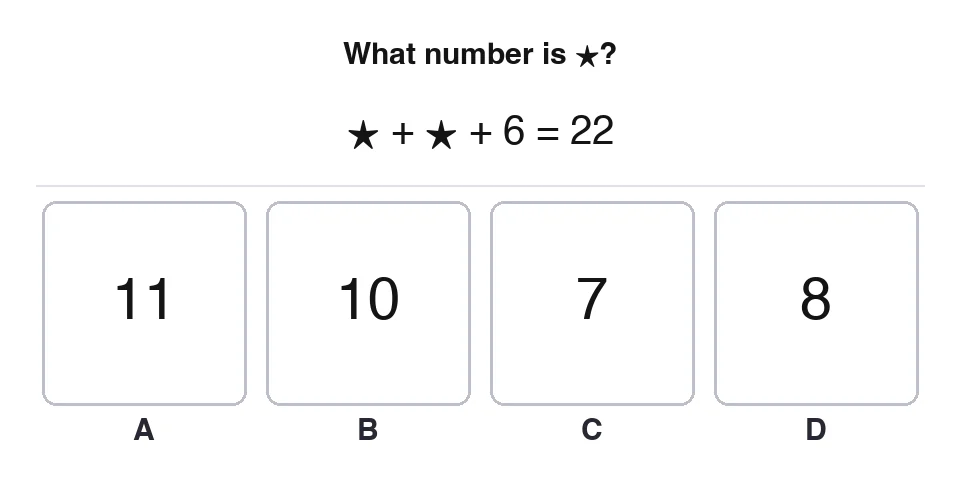
What number is ★?
★ + ★ + 6 = 22
Show answer
Answer: D (8). Take 6 from both sides: ★ + ★ = 16, so ★ = 8.
Verbal Battery
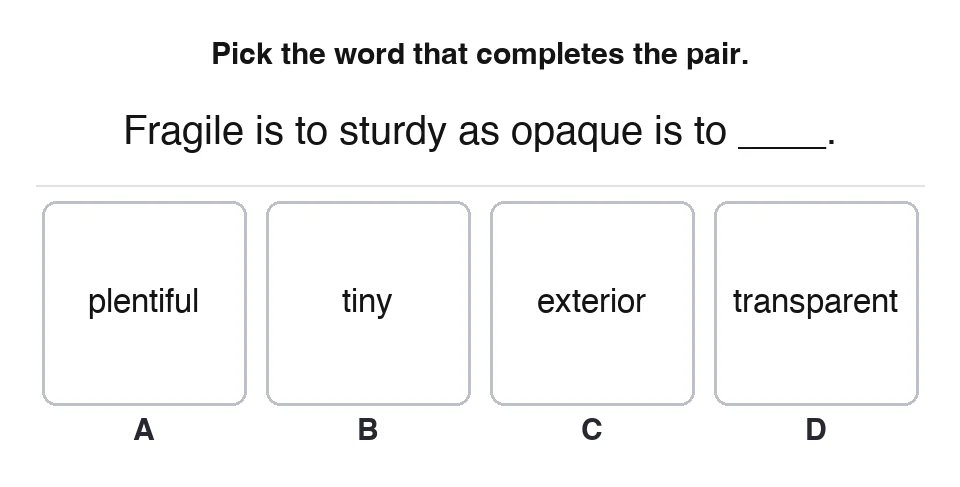
Pick the word that completes the pair.
Fragile is to sturdy as opaque is to ____.
Show answer
Answer: D (transparent). Fragile is the opposite of sturdy, and opaque is the opposite of transparent.
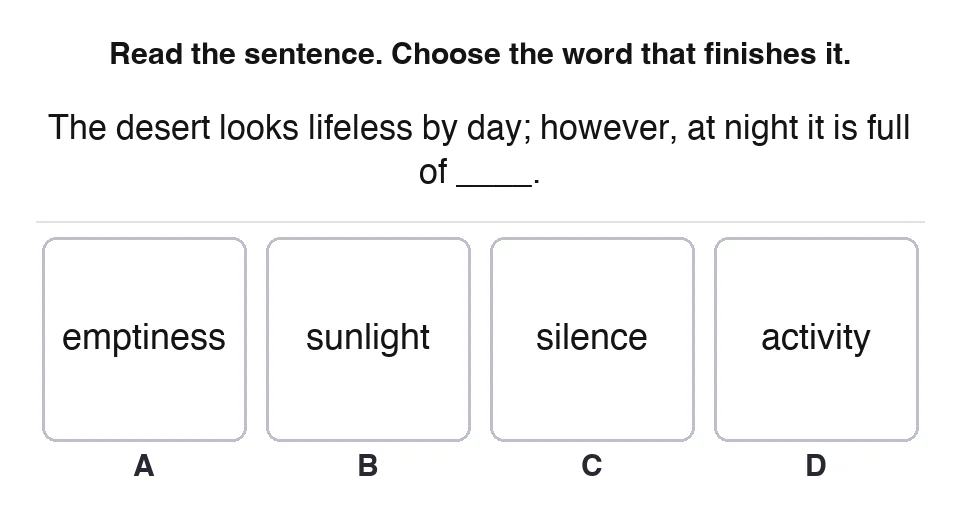
Read the sentence. Choose the word that finishes it.
The desert looks lifeless by day; however, at night it is full of ____.
Show answer
Answer: D (activity). "However" flips the idea. Lifeless by day means full of activity at night.
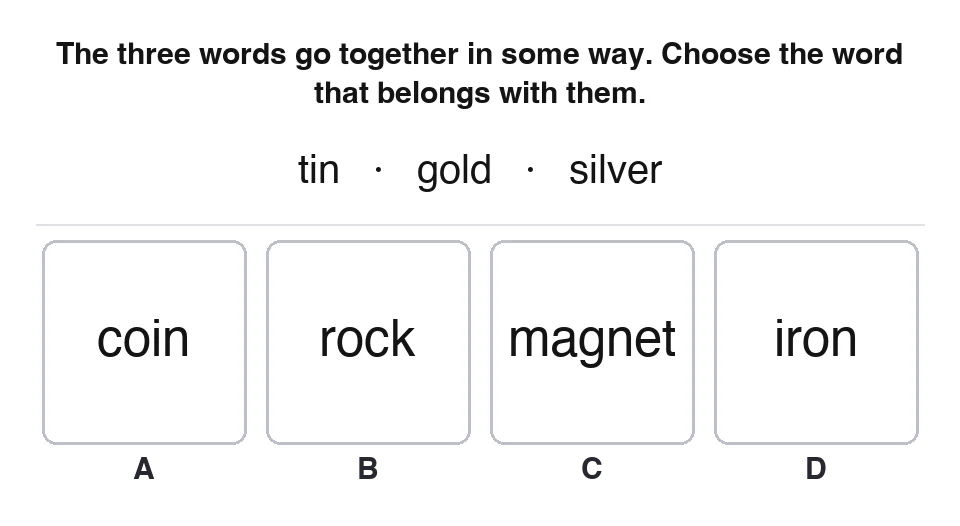
The three words go together in some way. Choose the word that belongs with them.
tin · gold · silver
Show answer
Answer: D (iron). Tin, gold, and silver are metals. So is iron. A coin is made of metal, but it is an object, not a metal.
Your child's practice profile
0 of 9 correct
About the 5th Grade CogAT (Level 11)
Fifth graders take CogAT Level 11, the most demanding of the elementary levels. Verbal analogies move from "what goes with what" to opposites and abstract relationships ("fragile is to sturdy"), sentence completion uses words like "however" in longer sentences, and paper folding can involve three folds and sixteen holes.
Fifth grade testing often decides placement in middle school advanced or accelerated programs, so the stakes can feel higher. The good news: at this age children can reflect on their own thinking, which makes practice with explanations especially effective.
What the Level 11 CogAT covers
| Battery | 5th Grade subtests (Level 11) |
|---|---|
| Verbal | Verbal Analogies (opposites and abstract relationships), Sentence Completion, Verbal Classification |
| Quantitative | Number Analogies (two-step rules), Number Puzzles, Number Series (each number built from earlier ones) |
| Nonverbal | Figure Matrices (three changes at once), Paper Folding with three folds, Figure Classification |
Print this test
All 9 questions on paper with answer bubbles, an answer key and a practice profile. Great for a test-like run at the kitchen table.
Free 5th Grade CogAT Practice Test PDF (Level 11)Tips for practicing with your 5th grader
- For two-step number analogies, test a rule on every pair before trusting it ("double, then subtract 3").
- In verbal classification, name the exact category ("metals") so near-misses like "coin" are easy to rule out.
- Have your child explain wrong answers back to you. Fifth graders learn the most from understanding the rule they missed.
- Practice pacing: about 30 to 40 seconds per question keeps a 10-minute subtest on track.
Practice by question type
Each question above links to a full guide. Here are all nine types on the Level 11 test:
- Verbal AnalogiesVerbal · Complete a word pair that follows the same relationship as the first pair.
- Sentence CompletionVerbal · Choose the word or picture that best completes a sentence.
- Verbal ClassificationVerbal · Find the category that links three words and choose the word that fits it.
- Number AnalogiesQuantitative · Find the rule that changes one number (or group) into another and apply it.
- Number PuzzlesQuantitative · Find the missing amount that makes both sides of an equation equal.
- Number SeriesQuantitative · Work out the pattern in a series and choose what comes next.
- Figure MatricesNonverbal · Find how the shapes change across the top row and apply it to the bottom row.
- Paper FoldingNonverbal · Picture a folded, hole-punched paper and choose how it looks unfolded.
- Figure ClassificationNonverbal · Find what three figures share and choose the figure that belongs with them.
Frequently asked questions
What level CogAT do 5th graders take?
Level 11. It has the same nine subtests and 10-minute time limits as Levels 9 and 10, with harder content.
Is the CogAT used for middle school placement?
Often, yes. Many districts use 5th grade CogAT results, together with achievement data, to place students in advanced or accelerated middle school courses.
What is the hardest part of the 5th grade CogAT?
Many students find paper folding with three folds and two-step number analogies the trickiest. Both become much easier once the strategy is clear.
How many questions are on the 5th grade CogAT?
At Levels 9 and above the full test has roughly 170 questions across nine subtests, about 90 minutes of timed testing in total.