
 By
Number Analogies is a subtest of the CogAT Quantitative Battery, given at every level, kindergarten through 12th grade. Find the rule that changes one number (or group) into another and apply it. It is also one of the three subtests on the CogAT Screening Form.
What number analogies questions measure
Number analogies measure quantitative reasoning: spotting the rule that turns one amount into another (add 1, double, multiply by 3, double then subtract 3) and applying it to a new number.
How number analogies questions work
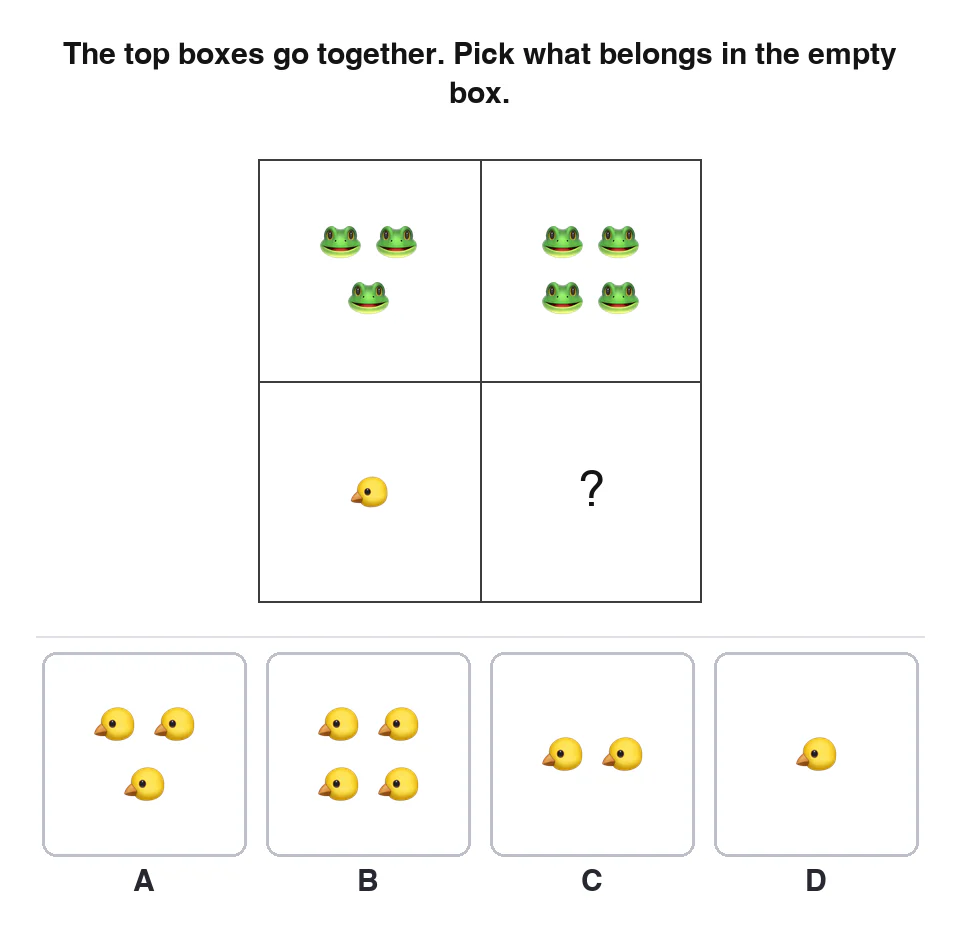
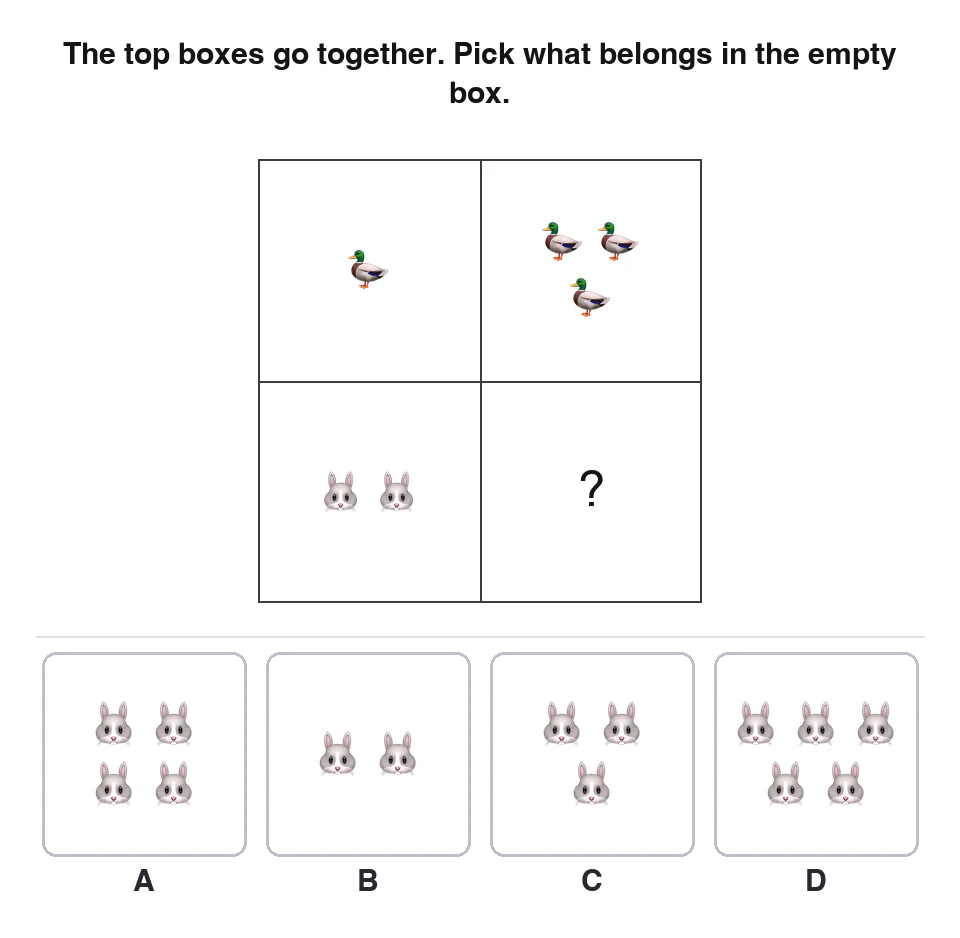
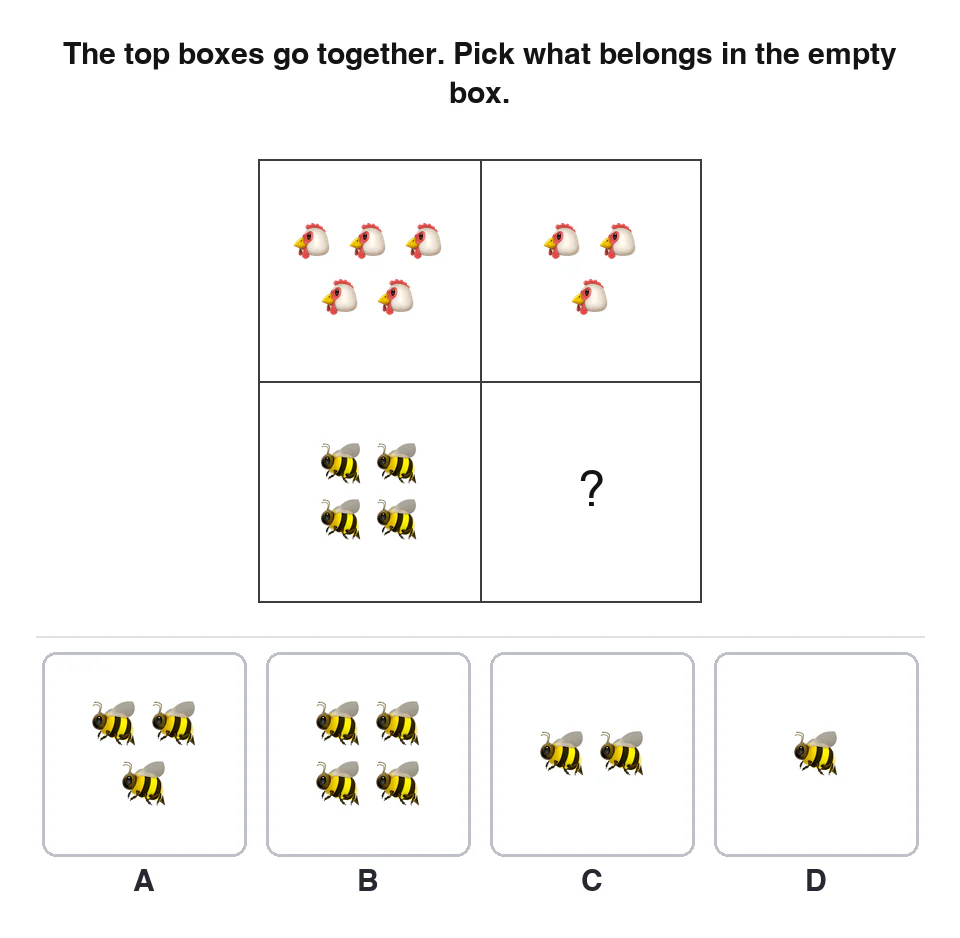
At Levels 5/6 to 8 the child compares groups of pictured objects in a grid. From Level 9 students see number pairs such as [4 → 8] [8 → 16] [6 → ?]. Number Analogies is the first subtest of the Quantitative Battery and part of the Screening Form.
How to solve number analogies questions
- Describe what happens in the first pair: "4 became 8."
- List possible rules: +4, or ×2.
- Test each rule on the second pair. Only ×2 works for 8 → 16.
- Apply the rule that works for every pair.
Number Analogies practice questions
6 examples, from kindergarten to 5th grade. Try each one before opening the answer.
Kindergarten (Level 5/6)
The top boxes go together. Pick what belongs in the empty box.
Show answer
Answer: C (2 chicks). 3 frogs become 4, one more. So 1 chick becomes 2.
Take the full kindergarten practice test
1st Grade (Level 7)
The top boxes go together. Pick what belongs in the empty box.
Show answer
Answer: A (4 rabbits). 1 duck becomes 3, two more. So 2 rabbits become 4.
Take the full 1st grade practice test
2nd Grade (Level 8)
The top boxes go together. Pick what belongs in the empty box.
Show answer
Answer: C (2 bees). 5 chickens become 3, two fewer. So 4 bees become 2.
Take the full 2nd grade practice test
3rd Grade (Level 9)
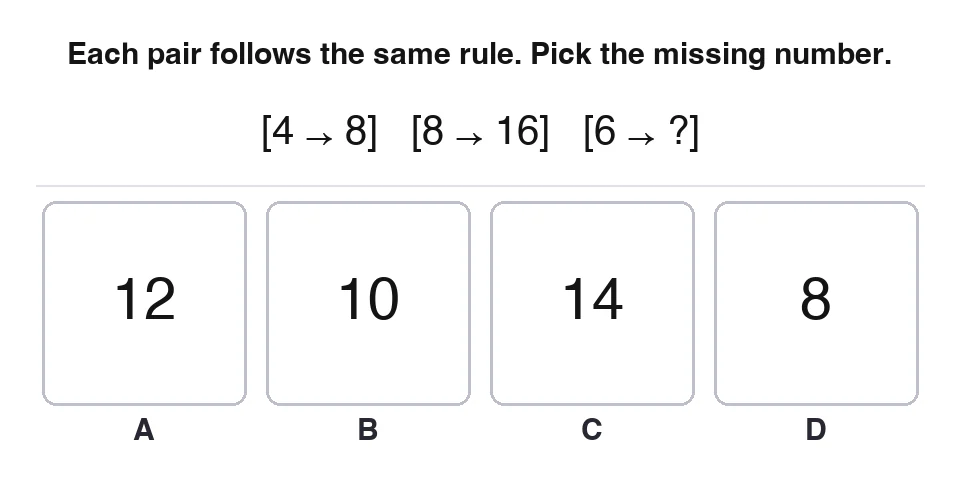
Each pair follows the same rule. Pick the missing number.
[4 → 8] [8 → 16] [6 → ?]
Show answer
Answer: A (12). Each number doubles: 4 to 8, 8 to 16, so 6 to 12.
Take the full 3rd grade practice test
4th Grade (Level 10)
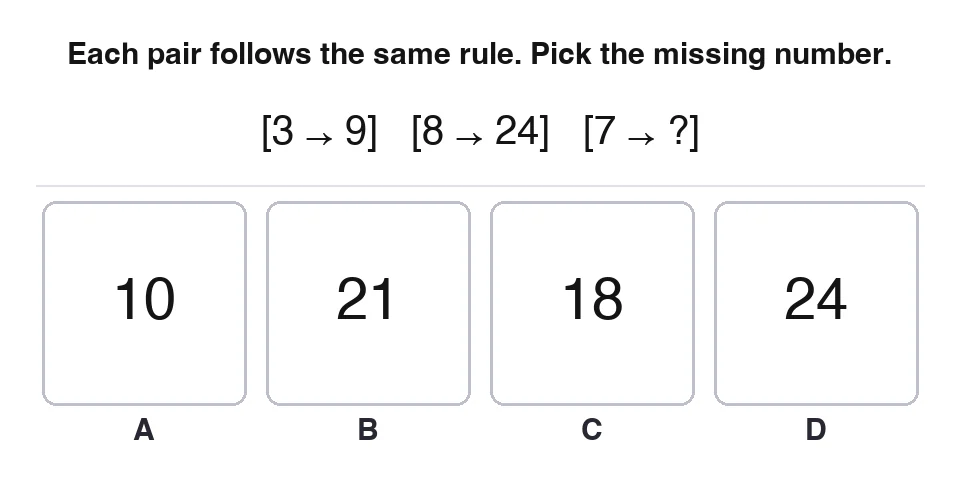
Each pair follows the same rule. Pick the missing number.
[3 → 9] [8 → 24] [7 → ?]
Show answer
Answer: B (21). Each number is multiplied by 3: 3 to 9, 8 to 24, so 7 to 21.
Take the full 4th grade practice test
5th Grade (Level 11)
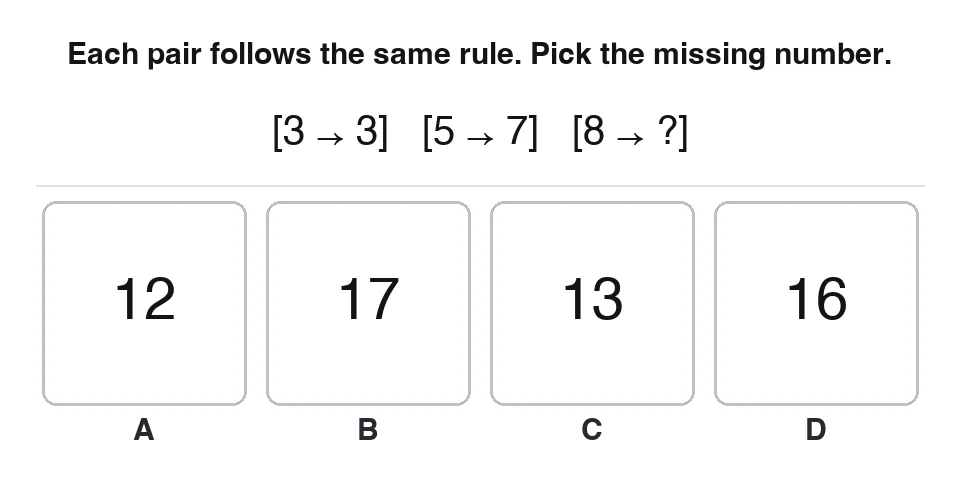
Each pair follows the same rule. Pick the missing number.
[3 → 3] [5 → 7] [8 → ?]
Show answer
Answer: C (13). Double, then subtract 3: 3 to 3, 5 to 7, so 8 to 13.
Take the full 5th grade practice test
Common mistakes
- Stopping at the first rule that fits one pair without checking the others.
- Miscounting objects in the picture versions.
Other quantitative question types
- Number PuzzlesFind the missing amount that makes both sides of an equation equal.
- Number SeriesWork out the pattern in a series and choose what comes next.
Frequently asked questions
What grades have number analogies on the CogAT?
Number Analogies appears at every level, kindergarten through 12th grade. This page has examples for Kindergarten, 1st Grade, 2nd Grade, 3rd Grade, 4th Grade and 5th Grade.
Which CogAT battery includes number analogies?
Number Analogies is part of the Quantitative Battery. The Quantitative Battery measures reasoning with numbers and quantities. It is about finding rules and patterns, not about school math facts.
How can my child get better at number analogies?
Learn the strategy above, then practice a few questions at a time and talk through each answer. Describe what happens in the first pair: "4 became 8."