
 By
Free CogAT practice test
2nd Grade CogAT Practice Test · Level 8
- Nonverbal
- Quantitative
- Verbal
Tip for parents: read each question aloud once, slowly, the way the test administrator will.
Nonverbal Battery
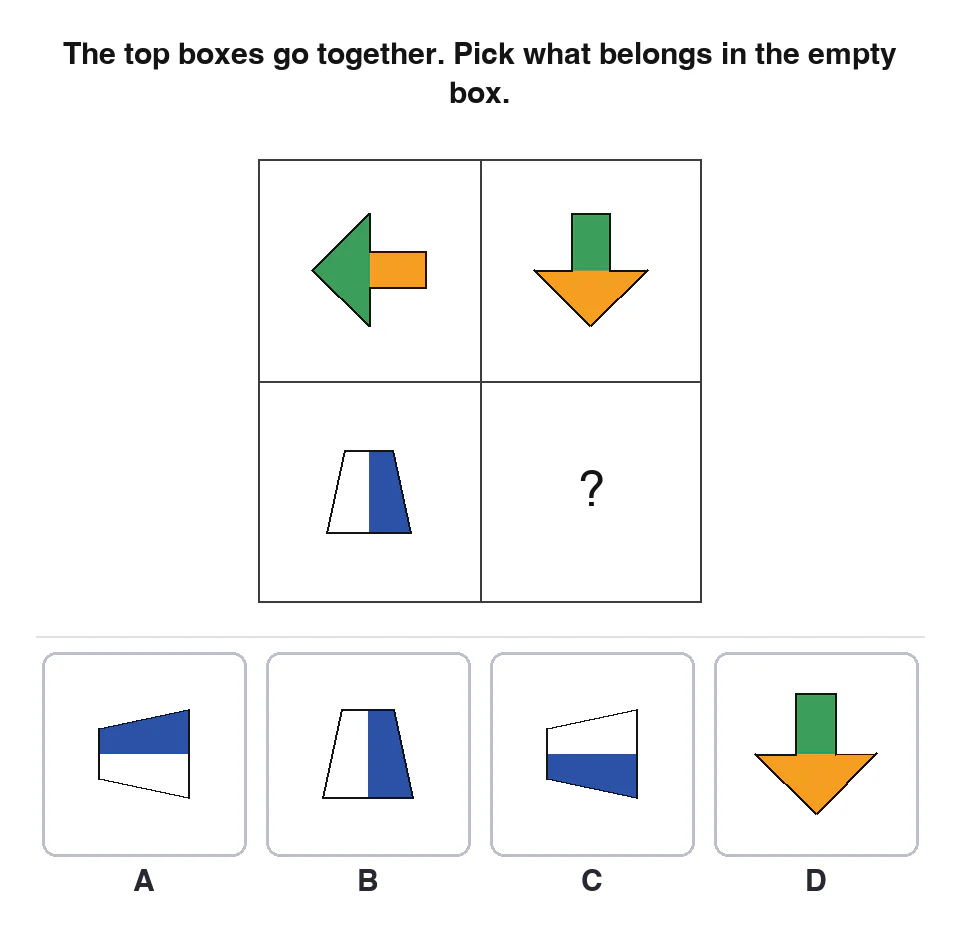
The top boxes go together. Pick what belongs in the empty box.
Show answer
Answer: C. The figure turns a quarter turn counterclockwise and the two halves trade colors. Do both to the trapezoid.
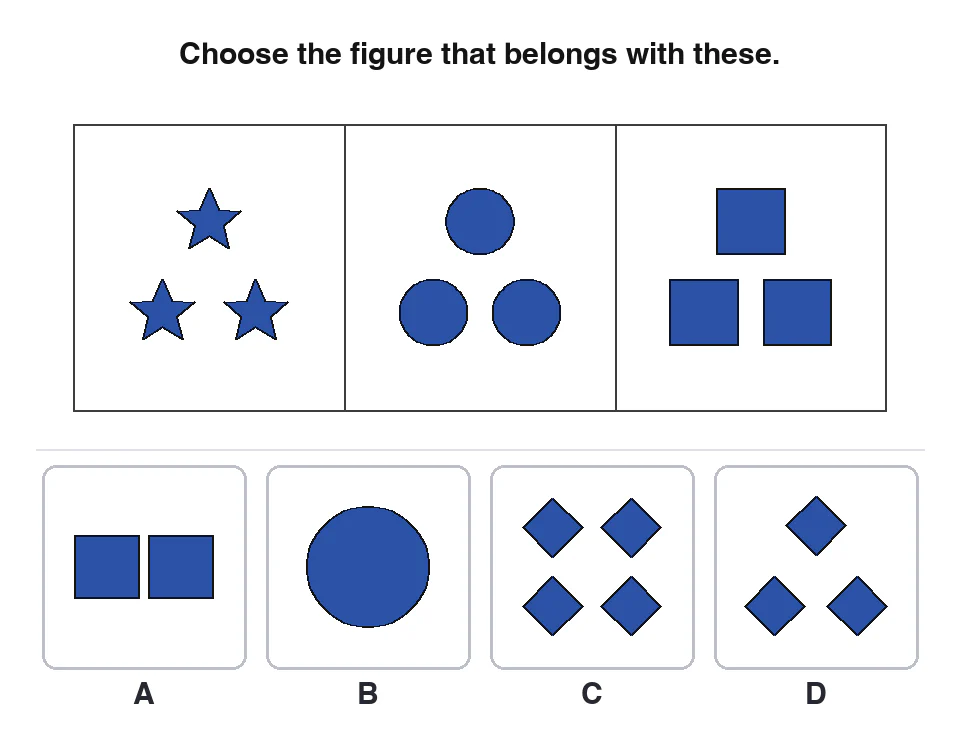
Choose the figure that belongs with these.
Show answer
Answer: D (3 diamonds). Every box has 3 shapes. D is the only other group of 3.
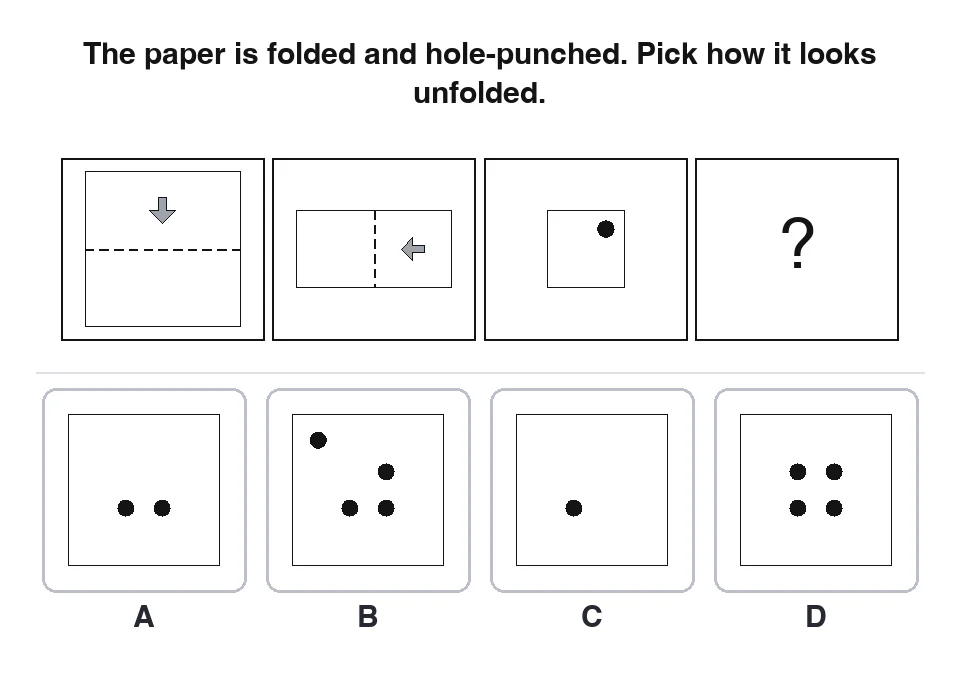
The paper is folded and hole-punched. Pick how it looks unfolded.
Show answer
Answer: D (4 holes in a square). Two folds make 4 layers, so one punch makes 4 holes, mirrored across both folds.
Quantitative Battery
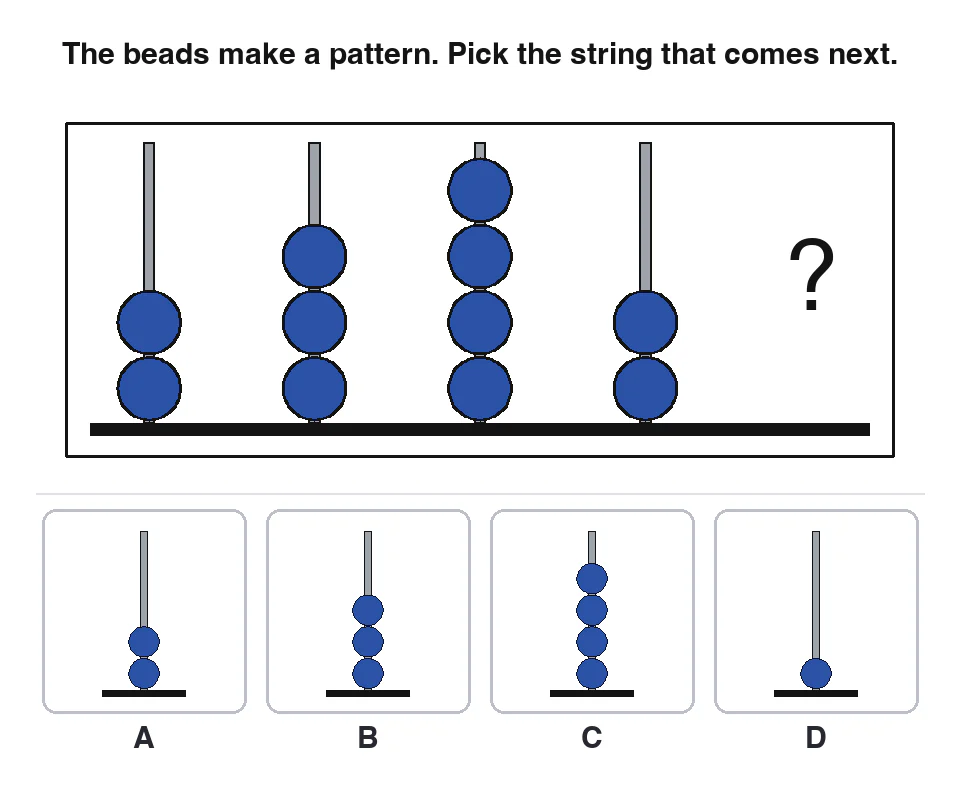
The beads make a pattern. Pick the string that comes next.
Show answer
Answer: B (3 beads). The counts repeat 2, 3, 4. After 2 comes 3.
The top boxes go together. Pick what belongs in the empty box.
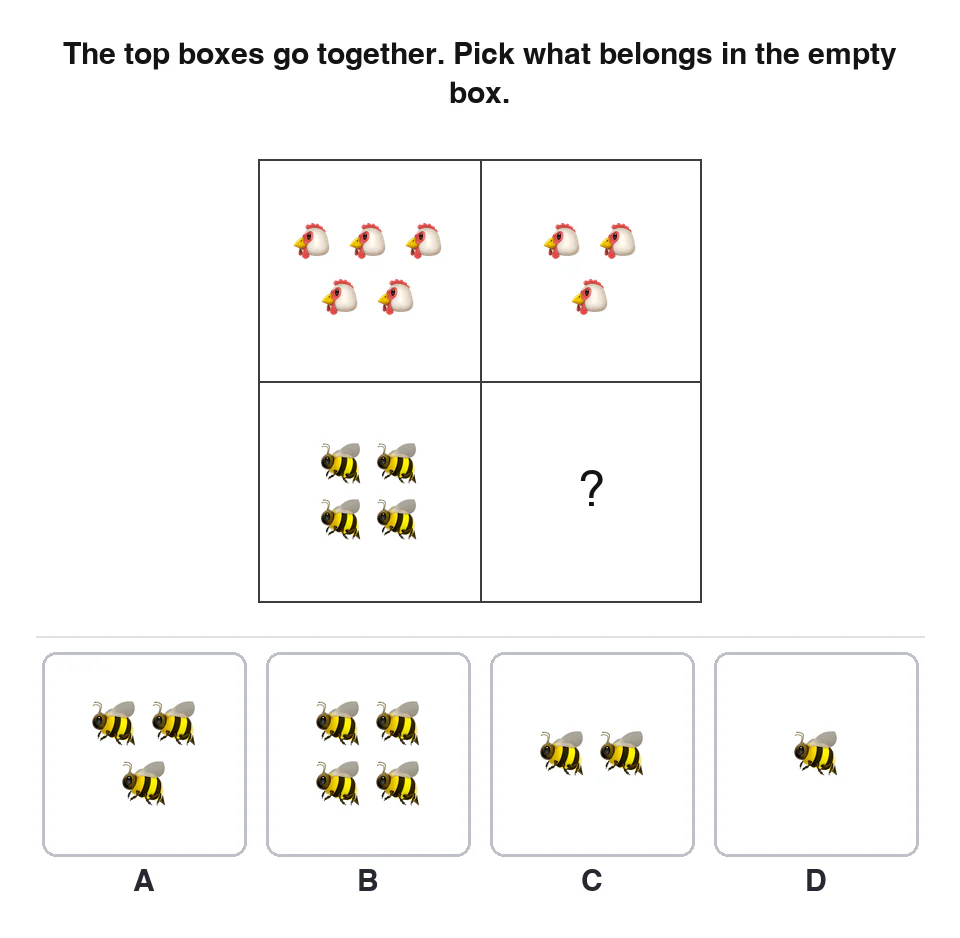
Show answer
Answer: C (2 bees). 5 chickens become 3, two fewer. So 4 bees become 2.
Both sides must have the same number. Pick the missing box.
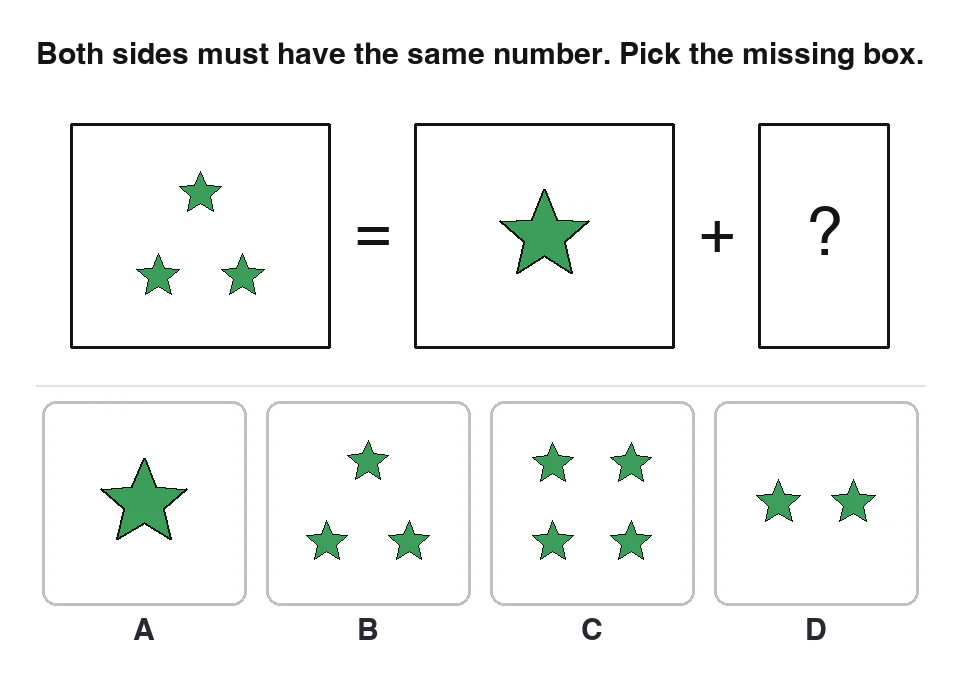
Show answer
Answer: D (2 stars). The left side has 3. The right side has 1, so it needs 2 more.
Verbal Battery
The first two pictures go together. Pick what goes with the third picture the same way.
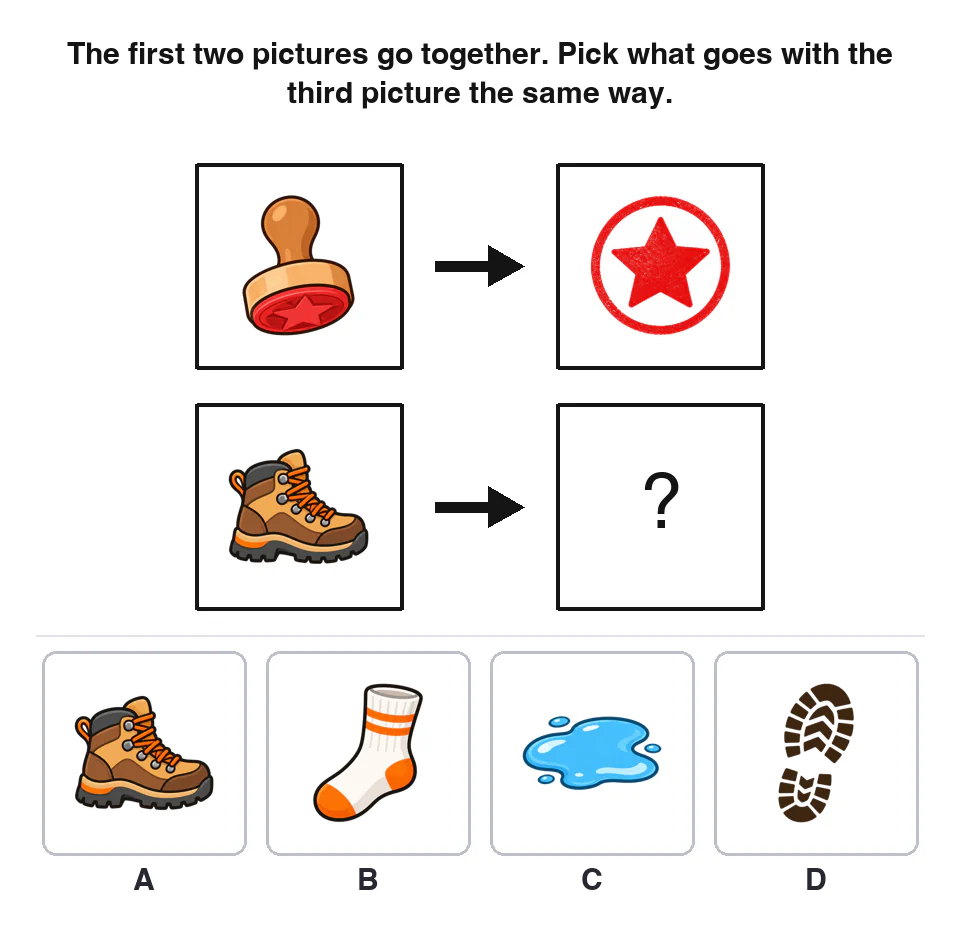
Show answer
Answer: D (footprint). A rubber stamp leaves a stamped star. A boot leaves a boot print.
Listen to the sentence. Pick the picture that finishes it.
The turtle moves slowly, but the ____ runs fast.
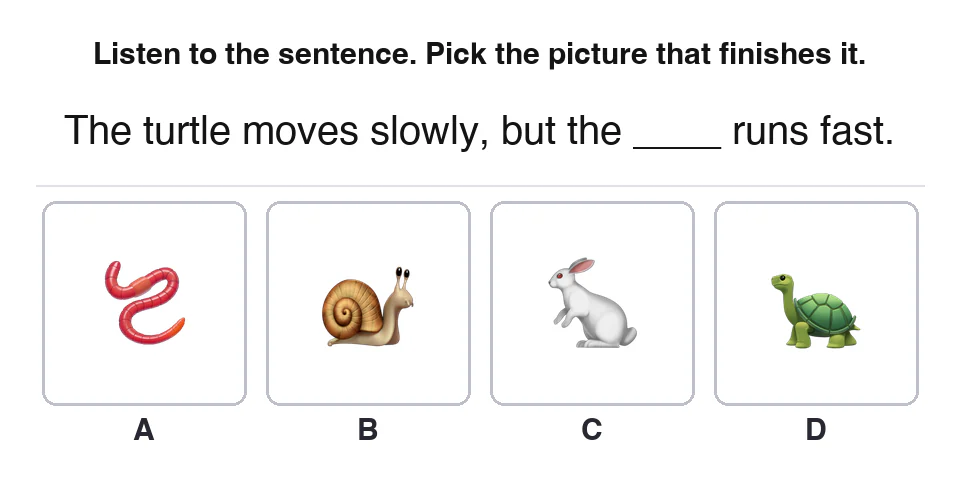
Show answer
Answer: C (rabbit). "But" signals a contrast. The turtle is slow, so the missing animal is fast.
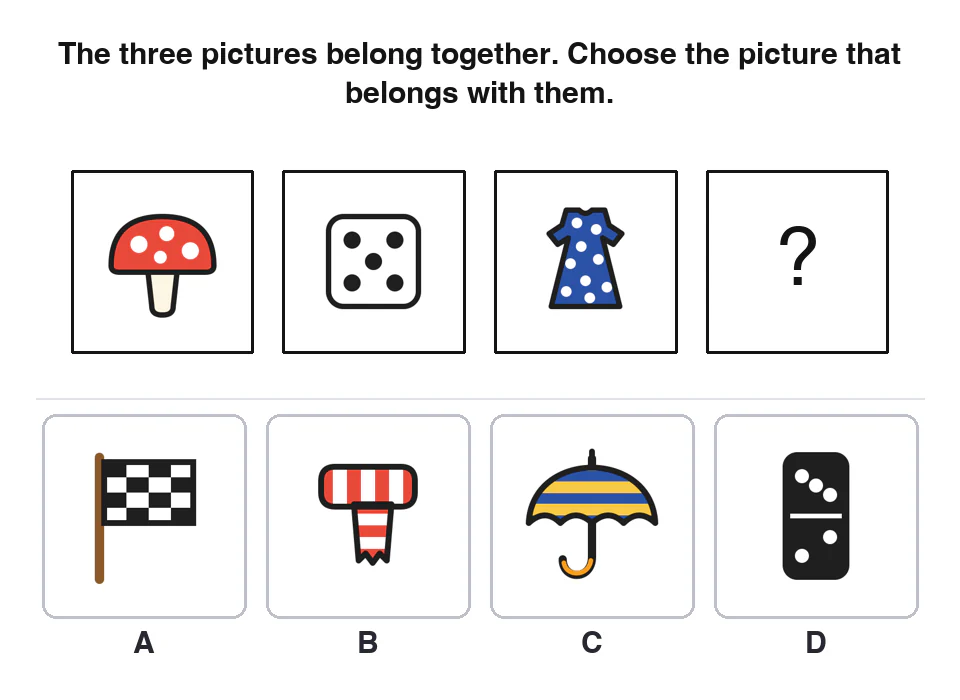
The three pictures belong together. Choose the picture that belongs with them.
Show answer
Answer: D (domino). The mushroom, dice, and dress all have spots. So does the domino. The flag is checkered and the other two are striped.
Your child's practice profile
0 of 9 correct
About the 2nd Grade CogAT (Level 8)
Second grade is the most common year to take the CogAT. Many districts run universal screening in 2nd grade, which means every child sits the test, not only those referred by a teacher. Second graders take CogAT Level 8, the last of the picture-based, read-aloud levels.
Level 8 questions ask for more abstract thinking than Levels 5/6 and 7. Analogies are about what things make or leave behind, sentence completion includes words like "but" that flip the meaning, and paper folding uses two folds, so one punch can become four holes. These are learnable patterns, and seeing them once makes a real difference on test day.
What the Level 8 CogAT covers
| Battery | 2nd Grade subtests (Level 8) |
|---|---|
| Verbal | Picture Analogies, Sentence Completion (listening, with contrast words), Picture Classification |
| Quantitative | Number Analogies (adding and taking away), Number Puzzles, Number Series (repeating patterns) |
| Nonverbal | Figure Matrices (shapes that gain or lose sides), Paper Folding with two folds, Figure Classification |
Print this test
All 9 questions on paper with answer bubbles, an answer key and a practice profile. Great for a test-like run at the kitchen table.
Free 2nd Grade CogAT Practice Test PDF (Level 8)Tips for practicing with your 2nd grader
- Listen for signal words in sentence completion: "but", "because", "so". They tell you which way the sentence goes.
- In number analogies, say the rule out loud before looking at the answers: "5 became 3, that is 2 fewer."
- For two-fold paper folding, count layers: two folds make four layers, so every punch makes four holes.
- If your child gets stuck, skip and come back. On the real test, every question is worth the same.
Practice by question type
Each question above links to a full guide. Here are all nine types on the Level 8 test:
- Picture AnalogiesVerbal · Find the relationship between two pictures and apply it to a third.
- Sentence CompletionVerbal · Choose the word or picture that best completes a sentence.
- Picture ClassificationVerbal · Find what three pictures have in common and pick the one that also belongs.
- Number AnalogiesQuantitative · Find the rule that changes one number (or group) into another and apply it.
- Number PuzzlesQuantitative · Find the missing amount that makes both sides of an equation equal.
- Number SeriesQuantitative · Work out the pattern in a series and choose what comes next.
- Figure MatricesNonverbal · Find how the shapes change across the top row and apply it to the bottom row.
- Paper FoldingNonverbal · Picture a folded, hole-punched paper and choose how it looks unfolded.
- Figure ClassificationNonverbal · Find what three figures share and choose the figure that belongs with them.
Frequently asked questions
Why do so many schools give the CogAT in 2nd grade?
Second grade is a common point for universal gifted screening. Children are old enough to sit a formal test, and programs that start in 3rd grade need results in time for placement.
What level CogAT is given in 2nd grade?
Level 8. It is the last picture-based, read-aloud level. From Level 9 (3rd grade) students read the questions themselves.
Is the 2nd grade CogAT hard?
It is built to stretch every student, from average to highly gifted, so almost everyone finds some questions hard. That is normal and expected. Familiarity with the formats helps your child stay calm when a question looks tricky.
What is a good CogAT score for 2nd grade?
A Standard Age Score (SAS) of 100 is exactly average. Gifted programs commonly look for composites around the 95th percentile or higher (roughly SAS 126 and up), but criteria vary by district.