
 By
Free CogAT practice test
1st Grade CogAT Practice Test · Level 7
- Nonverbal
- Quantitative
- Verbal
Tip for parents: read each question aloud once, slowly, the way the test administrator will.
Nonverbal Battery
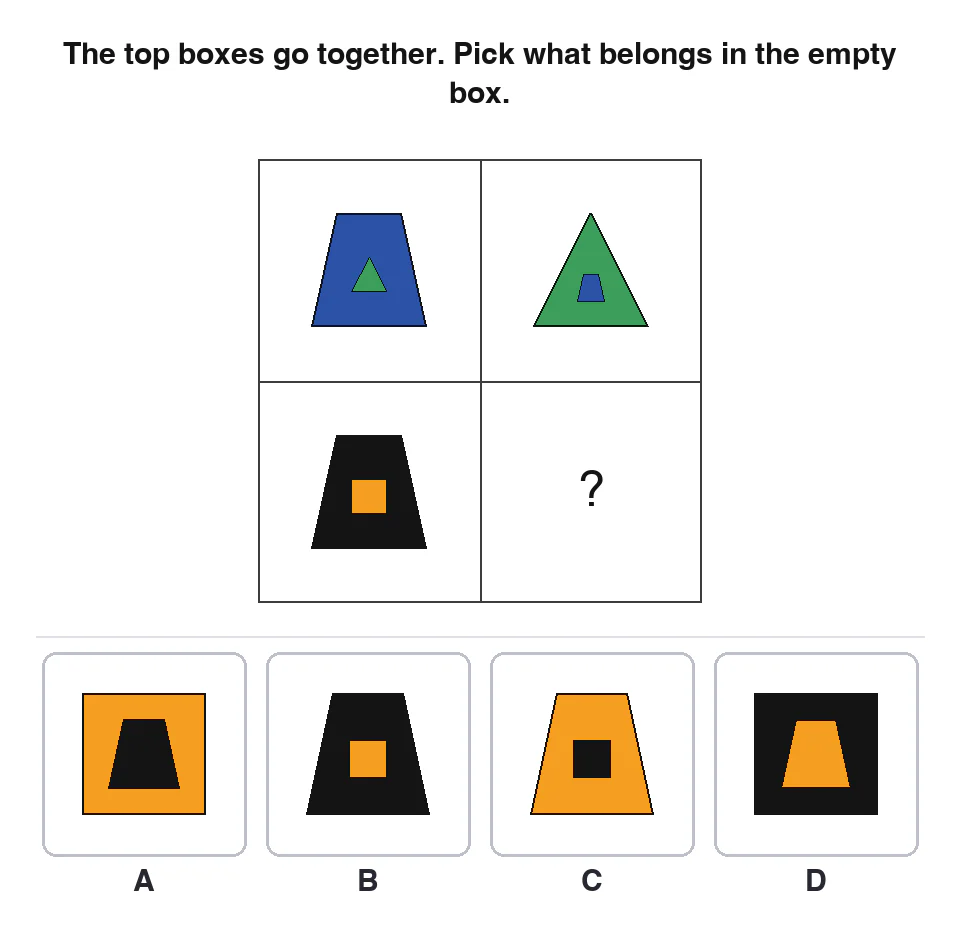
The top boxes go together. Pick what belongs in the empty box.
Show answer
Answer: A. The inside and outside shapes trade places, and each keeps its color. The orange square goes outside, the black trapezoid inside.
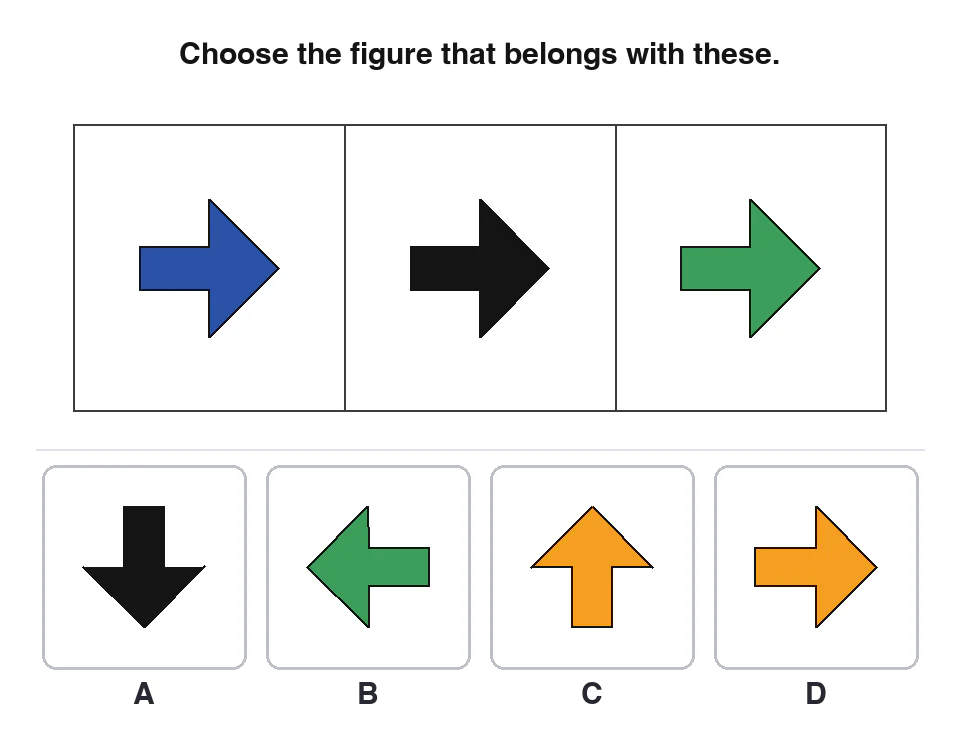
Choose the figure that belongs with these.
Show answer
Answer: D (orange arrow). All three arrows point right. Only D points right too.
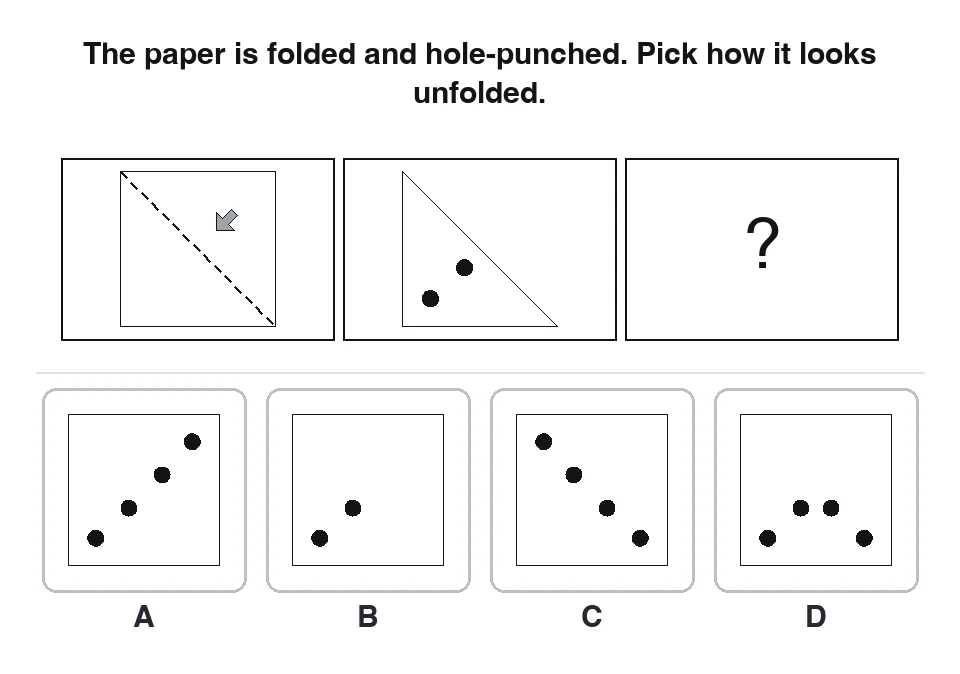
The paper is folded and hole-punched. Pick how it looks unfolded.
Show answer
Answer: A (4 holes along a diagonal). The corner folds on the slanted line. Each hole gets a twin across that line, so 2 holes become 4.
Quantitative Battery
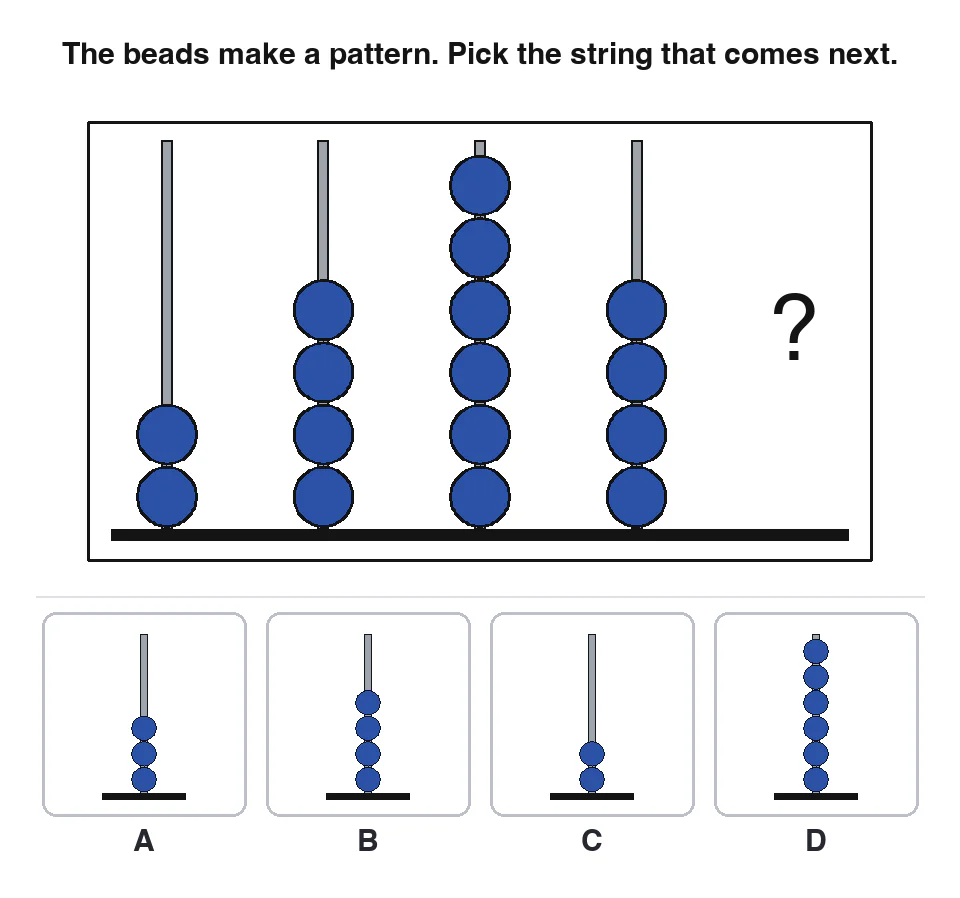
The beads make a pattern. Pick the string that comes next.
Show answer
Answer: C (2 beads). The beads climb and come back down: 2, 4, 6, 4, so 2 comes next.
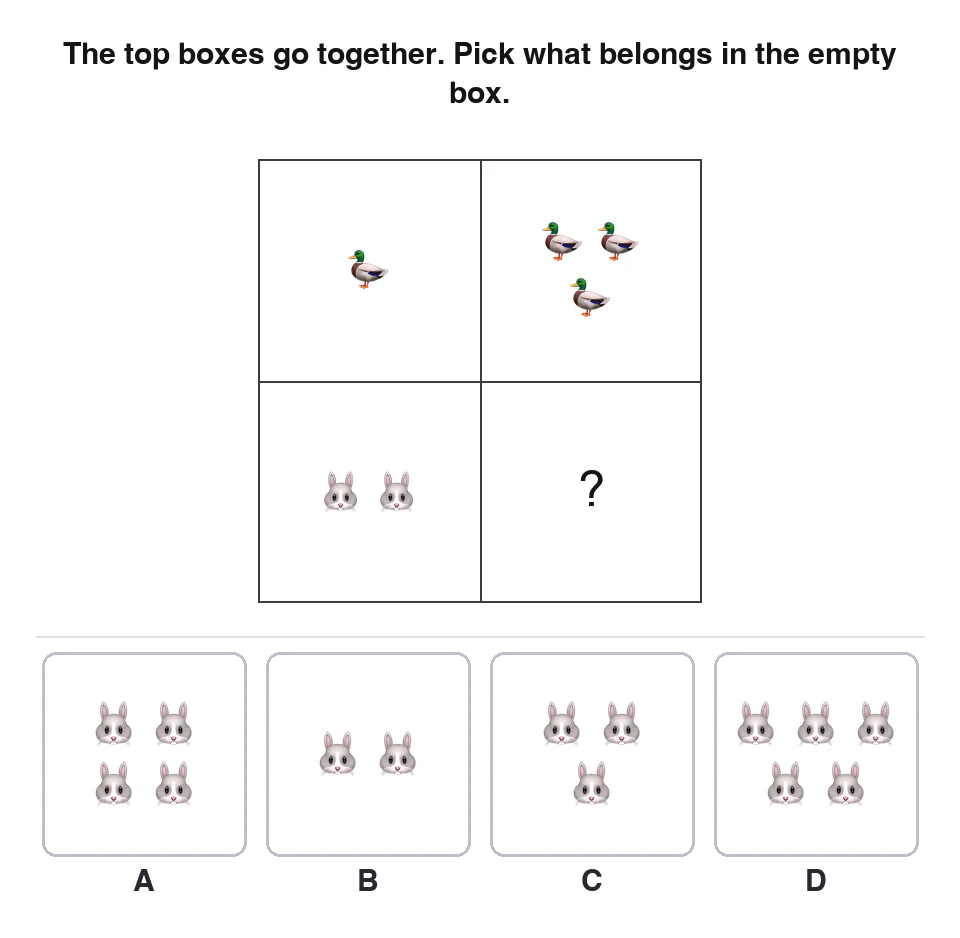
The top boxes go together. Pick what belongs in the empty box.
Show answer
Answer: A (4 rabbits). 1 duck becomes 3, two more. So 2 rabbits become 4.
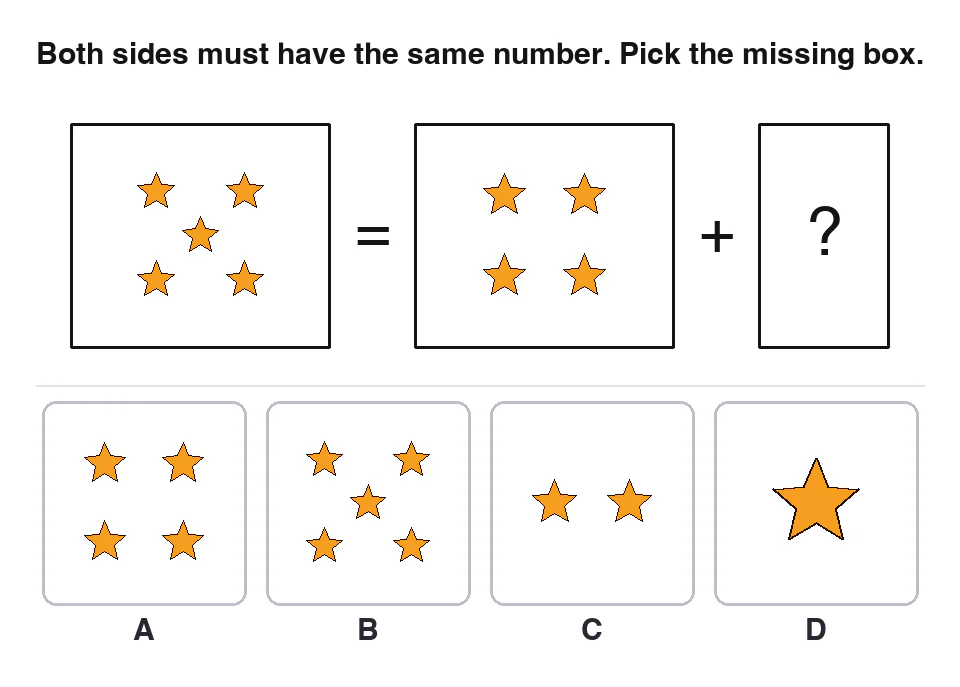
Both sides must have the same number. Pick the missing box.
Show answer
Answer: D (1 star). The left side has 5. The right side has 4, so it needs 1 more.
Verbal Battery
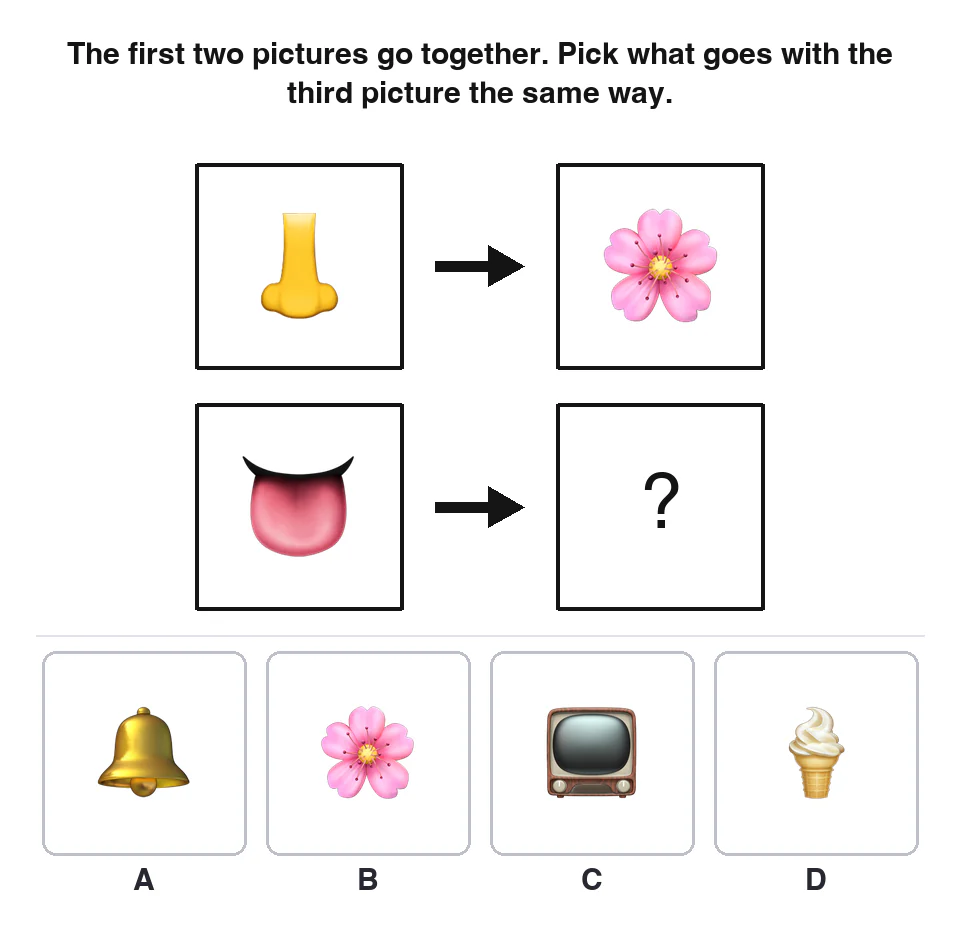
The first two pictures go together. Pick what goes with the third picture the same way.
Show answer
Answer: D (ice cream cone). You smell flowers with your nose. You taste ice cream with your tongue.
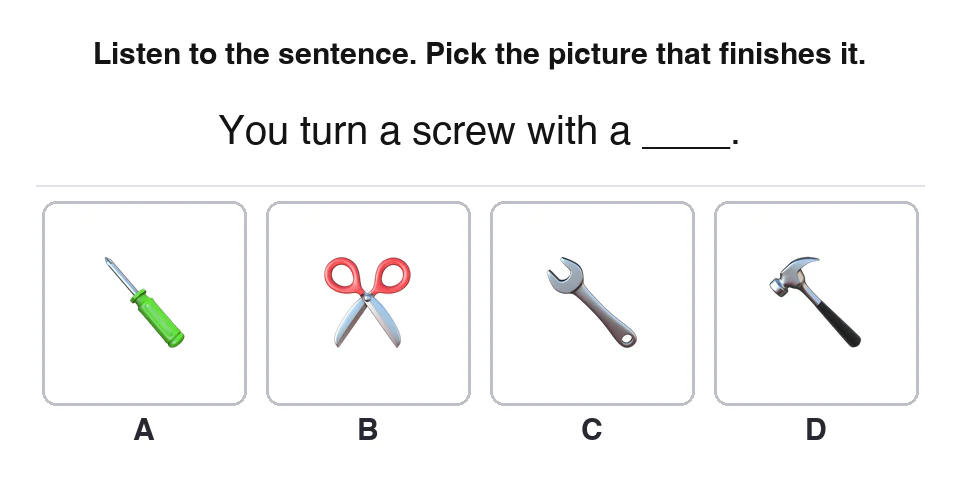
Listen to the sentence. Pick the picture that finishes it.
You turn a screw with a ____.
Show answer
Answer: A (screwdriver). You turn a screw with a screwdriver. A wrench turns bolts.
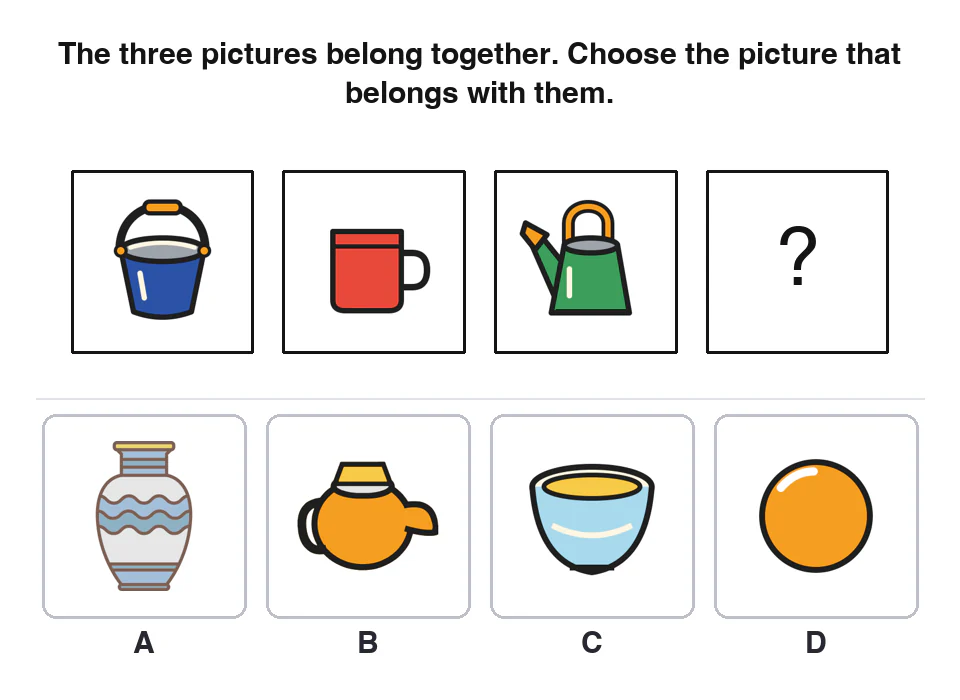
The three pictures belong together. Choose the picture that belongs with them.
Show answer
Answer: B (teapot). The bucket, mug, and watering can all have handles. So does the teapot.
Your child's practice profile
0 of 9 correct
About the 1st Grade CogAT (Level 7)
First graders take CogAT Level 7. Like kindergarten, it is a picture-based, read-aloud test, but the questions get noticeably harder. Analogies rely on less obvious relationships (what something produces or is used for, not just what it looks like), number series start to go up and down, and paper folding introduces diagonal folds.
Level 7 is also where many children meet the CogAT for the first time, because a lot of districts screen in first grade for gifted and talented programs. If your child has never seen these question types, a short practice run is the single most useful thing you can do.
What the Level 7 CogAT covers
| Battery | 1st Grade subtests (Level 7) |
|---|---|
| Verbal | Picture Analogies, Sentence Completion (listening), Picture Classification |
| Quantitative | Number Analogies, Number Puzzles, Number Series (bead strings) |
| Nonverbal | Figure Matrices, Paper Folding (including diagonal folds), Figure Classification |
Print this test
All 9 questions on paper with answer bubbles, an answer key and a practice profile. Great for a test-like run at the kitchen table.
Free 1st Grade CogAT Practice Test PDF (Level 7)Tips for practicing with your 1st grader
- Talk about relationships at home: "A cow gives milk. What does a chicken give?" This is exactly what picture analogies test.
- For number series, count the beads on each string out loud and say the pattern: "2, 4, 6, then 4. Up, up, down..."
- Fold and punch real paper. Ten minutes with a hole punch teaches paper folding faster than any worksheet.
- Praise careful checking, not speed. Level 7 is not strictly timed.
Practice by question type
Each question above links to a full guide. Here are all nine types on the Level 7 test:
- Picture AnalogiesVerbal · Find the relationship between two pictures and apply it to a third.
- Sentence CompletionVerbal · Choose the word or picture that best completes a sentence.
- Picture ClassificationVerbal · Find what three pictures have in common and pick the one that also belongs.
- Number AnalogiesQuantitative · Find the rule that changes one number (or group) into another and apply it.
- Number PuzzlesQuantitative · Find the missing amount that makes both sides of an equation equal.
- Number SeriesQuantitative · Work out the pattern in a series and choose what comes next.
- Figure MatricesNonverbal · Find how the shapes change across the top row and apply it to the bottom row.
- Paper FoldingNonverbal · Picture a folded, hole-punched paper and choose how it looks unfolded.
- Figure ClassificationNonverbal · Find what three figures share and choose the figure that belongs with them.
Frequently asked questions
What level of the CogAT do 1st graders take?
First graders take Level 7. It is picture-based and read aloud, with the same nine subtests as other levels.
Is the 1st grade CogAT timed?
Primary levels (5/6, 7 and 8) are paced by the person giving the test rather than run on a strict clock, though each session has a typical length. Students at Level 9 and above get a fixed 10 minutes per subtest.
What score does a 1st grader need for gifted programs?
It depends entirely on the district. Many programs look for a composite at or above the 95th to 98th percentile, often alongside other measures such as teacher ratings or an achievement test. Check your district's published criteria.
Can my 1st grader practice for the CogAT?
Yes. Riverside describes CogAT as measuring developed reasoning, and familiarity with the formats helps children show what they can actually do instead of being thrown by unfamiliar question types.