
 By
Paper Folding is a subtest of the CogAT Nonverbal Battery, given at every level, kindergarten through 12th grade. Picture a folded, hole-punched paper and choose how it looks unfolded.
What paper folding questions measure
Paper folding measures spatial visualization: holding a folded shape in mind and mentally unfolding it, reflecting each hole across each fold.
How paper folding questions work
Students see a square of paper folded one or more times, then punched. They choose the picture that shows where the holes are when the paper is opened.
How to solve paper folding questions
- Count the folds. Each fold doubles the layers: 1 fold = 2 layers, 2 folds = 4, 3 folds = 8.
- Multiply: holes punched × layers = holes in the answer.
- Unfold in reverse order, mirroring holes across each fold line.
- Eliminate choices with the wrong number of holes first.
Paper Folding practice questions
6 examples, from kindergarten to 5th grade. Try each one before opening the answer.
Kindergarten (Level 5/6)
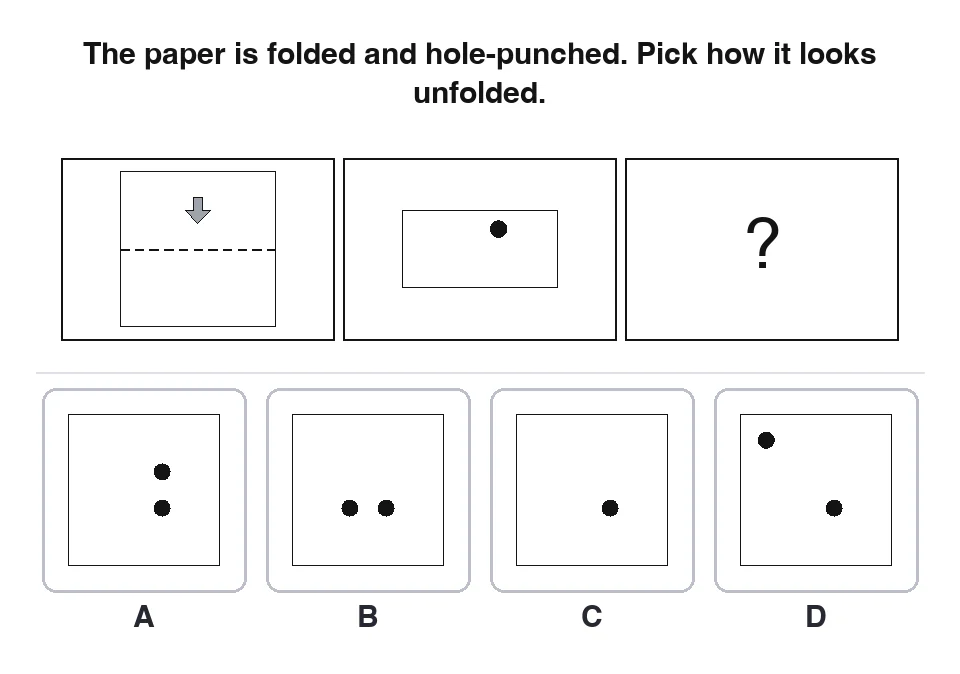
The paper is folded and hole-punched. Pick how it looks unfolded.
Show answer
Answer: A (2 holes, one above the other). The top folds down, so the hole repeats across the fold: 2 holes, one above the other.
Take the full kindergarten practice test
1st Grade (Level 7)
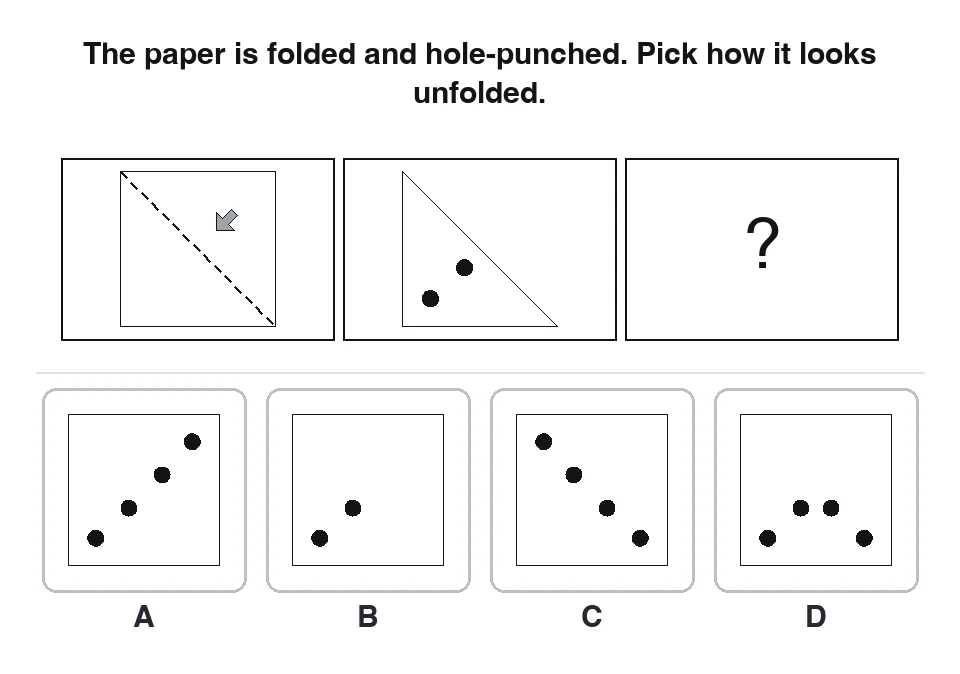
The paper is folded and hole-punched. Pick how it looks unfolded.
Show answer
Answer: A (4 holes along a diagonal). The corner folds on the slanted line. Each hole gets a twin across that line, so 2 holes become 4.
Take the full 1st grade practice test
2nd Grade (Level 8)
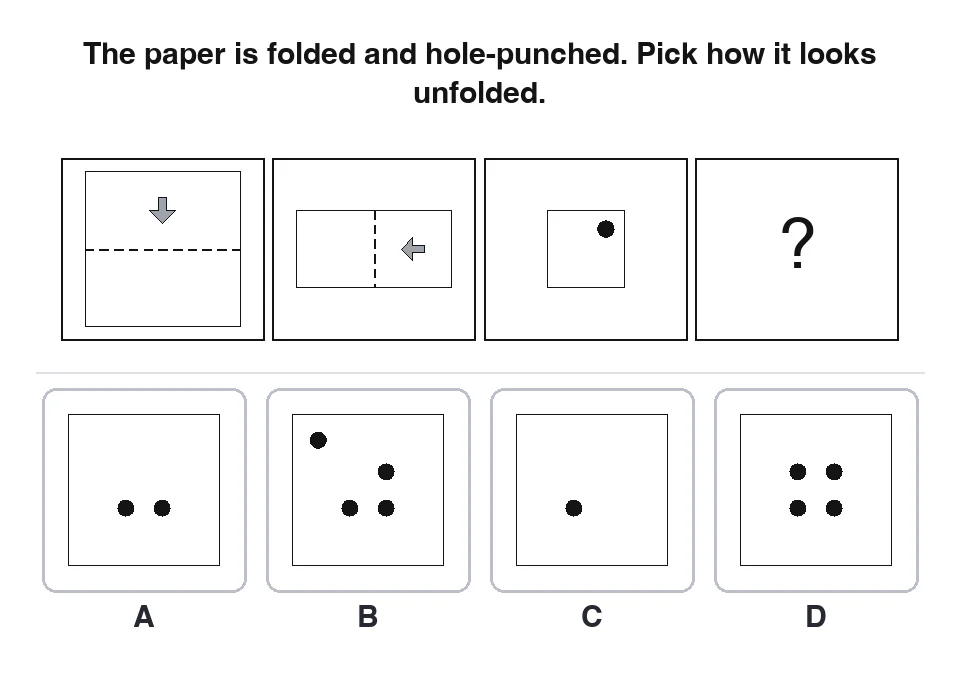
The paper is folded and hole-punched. Pick how it looks unfolded.
Show answer
Answer: D (4 holes in a square). Two folds make 4 layers, so one punch makes 4 holes, mirrored across both folds.
Take the full 2nd grade practice test
3rd Grade (Level 9)
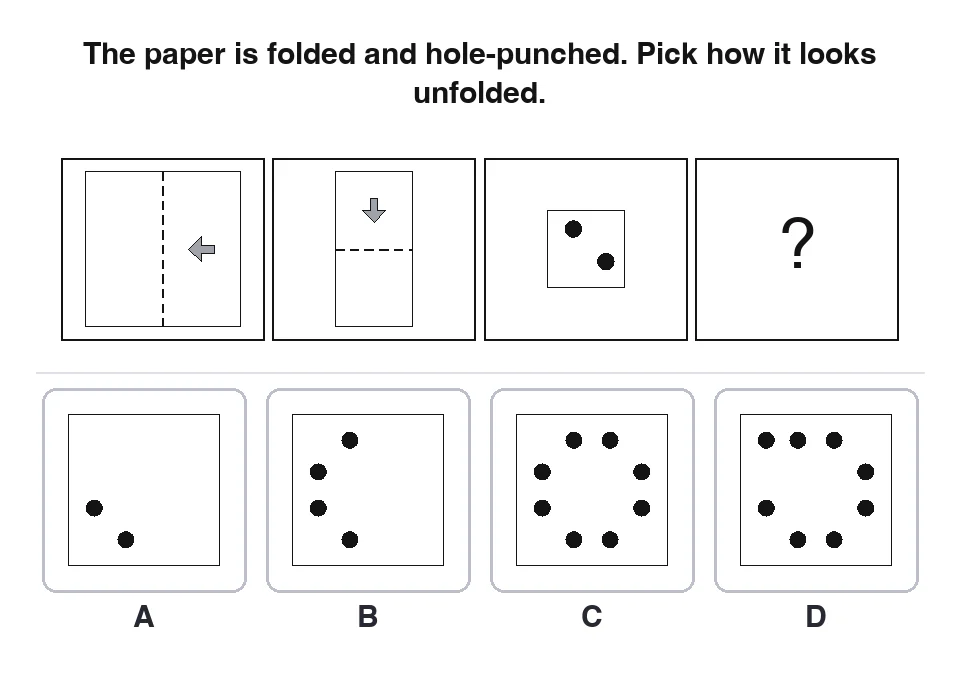
The paper is folded and hole-punched. Pick how it looks unfolded.
Show answer
Answer: C (8 holes in a ring). Two folds make 4 layers, so the 2 punched holes become 8, mirrored across both folds.
Take the full 3rd grade practice test
4th Grade (Level 10)
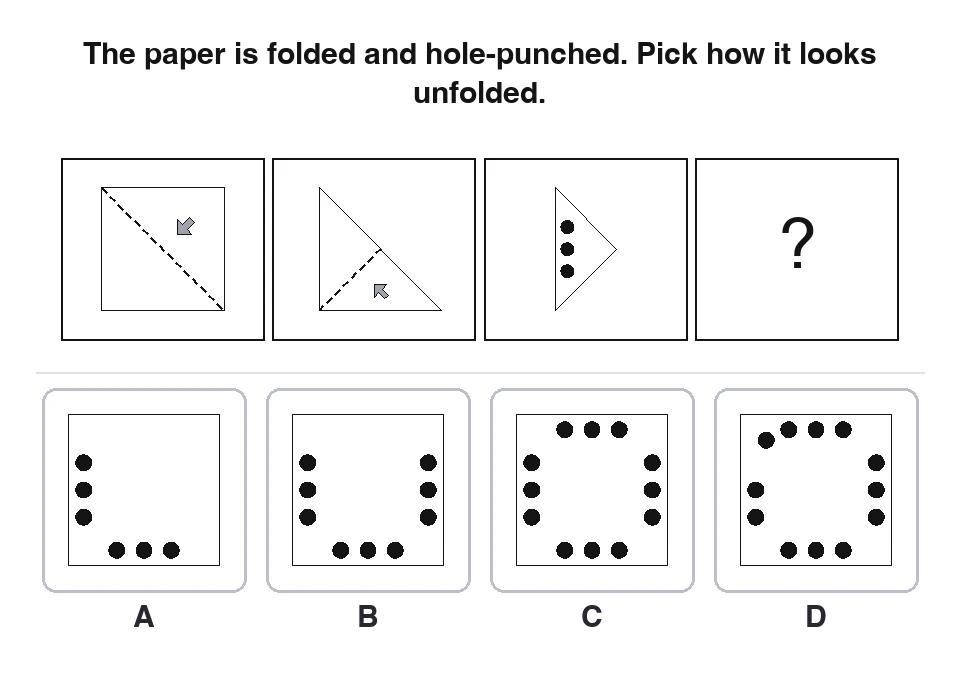
The paper is folded and hole-punched. Pick how it looks unfolded.
Show answer
Answer: C (12 holes on all four sides). Two diagonal folds make 4 layers, so the 3 punched holes become 12, mirrored across both folds.
Take the full 4th grade practice test
5th Grade (Level 11)
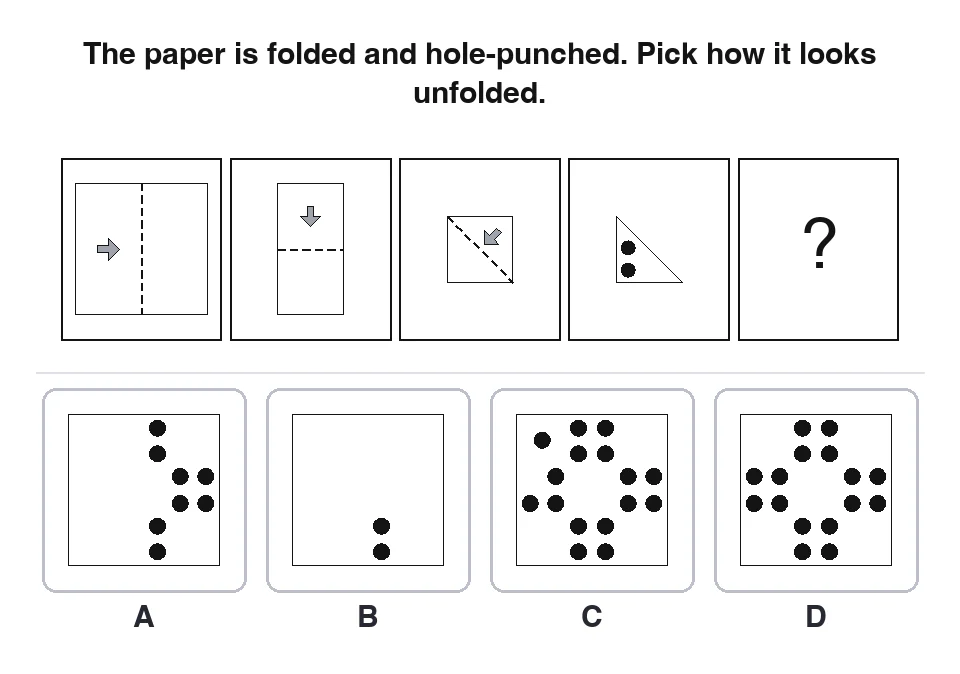
The paper is folded and hole-punched. Pick how it looks unfolded.
Show answer
Answer: D (16 holes in a symmetric pattern). Three folds make 8 layers, so the 2 punched holes become 16, mirrored back across each fold.
Take the full 5th grade practice test
Common mistakes
- Forgetting that a hole on the fold line does not double the same way.
- Mirroring across the wrong line on diagonal folds.
Other nonverbal question types
- Figure MatricesFind how the shapes change across the top row and apply it to the bottom row.
- Figure ClassificationFind what three figures share and choose the figure that belongs with them.
Frequently asked questions
What grades have paper folding on the CogAT?
Paper Folding appears at every level, kindergarten through 12th grade. This page has examples for Kindergarten, 1st Grade, 2nd Grade, 3rd Grade, 4th Grade and 5th Grade.
Which CogAT battery includes paper folding?
Paper Folding is part of the Nonverbal Battery. The Nonverbal Battery measures reasoning with shapes and figures. No reading or language is involved, so it is often the fairest measure for English learners.
How can my child get better at paper folding?
Learn the strategy above, then practice a few questions at a time and talk through each answer. Count the folds. Each fold doubles the layers: 1 fold = 2 layers, 2 folds = 4, 3 folds = 8.