
 By
The CogAT has 3 batteries (Verbal, Quantitative, Nonverbal) with 3 subtests each, 9 subtests in total. At Levels 9 and up every subtest is timed at 10 minutes, about 90 minutes of testing, usually split over several sessions. Levels 5/6 to 8 are picture-based, read aloud and paced by the teacher.
The three batteries
A battery is a group of related subtests. Each battery produces its own score, and the three together produce the overall composite.
| Battery | What it measures | Subtests |
|---|---|---|
| Verbal | Reasoning with words and concepts; vocabulary and comprehension in context | Verbal (Picture) Analogies, Sentence Completion, Verbal (Picture) Classification |
| Quantitative | Reasoning with numbers and quantities; spotting numeric rules and patterns | Number Analogies, Number Puzzles, Number Series |
| Nonverbal | Reasoning with shapes; spatial visualization and abstract patterns | Figure Matrices, Paper Folding, Figure Classification |
Primary levels (K to 2nd grade) vs Level 9 and up
The biggest change in the whole test happens between 2nd and 3rd grade.
| Levels 5/6, 7, 8 (K-2) | Levels 9 to 17/18 (3rd grade up) | |
|---|---|---|
| Who reads the questions | The teacher (or recorded audio online) | The student |
| Verbal subtests | All pictures | Written words |
| Quantitative subtests | Pictured objects and bead strings | Written numbers and symbols |
| Timing | Paced by the administrator | 10 minutes per subtest |
This shift is why many strong students find 3rd grade the hardest CogAT year. If your child is moving into Level 9, our 3rd grade CogAT practice test shows the new written formats.
How many questions are on the CogAT?
At Levels 9 and above, the full test has roughly 170 questions in total, with about 16 to 22 in each subtest. The primary levels have fewer questions, because young children work more slowly and every item is read aloud. Exact counts vary slightly by level and form.
How long does the CogAT take?
- Level 9 and up: 10 minutes per subtest, about 90 minutes of timed testing for all nine subtests. Directions and breaks add time, so schools usually spread the test over two to four sessions.
- Levels 5/6 to 8: not strictly timed. The teacher reads each question and moves on when the group is ready. The whole test is normally given over several short sessions across a few days.
- Screening Form: only three subtests, about 30 minutes of testing at Level 9 and up.
What each subtest looks like
Here is one example from each battery. Every question type has its own guide with a strategy and examples from kindergarten to 5th grade.
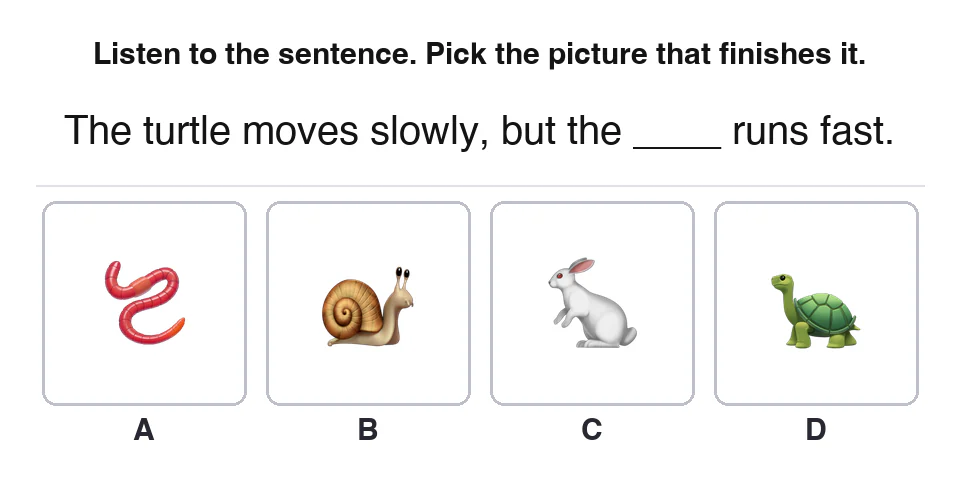
Verbal: Sentence Completion (2nd grade)
Listen to the sentence. Pick the picture that finishes it.
The turtle moves slowly, but the ____ runs fast.
Show answer
Answer: C (rabbit). "But" signals a contrast. The turtle is slow, so the missing animal is fast.
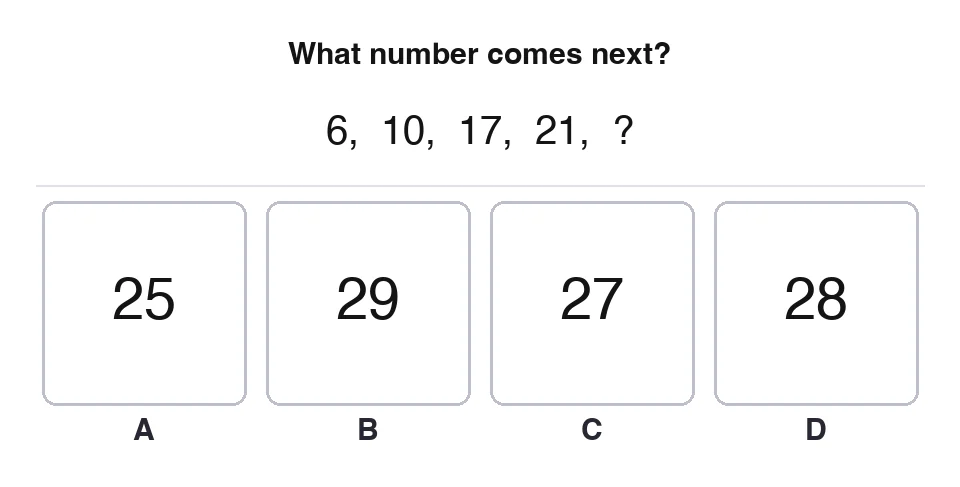
Quantitative: Number Series (4th grade)
What number comes next?
6, 10, 17, 21, ?
Show answer
Answer: D (28). The jumps take turns: +4, +7, +4. Next is +7, so 21 + 7 = 28.
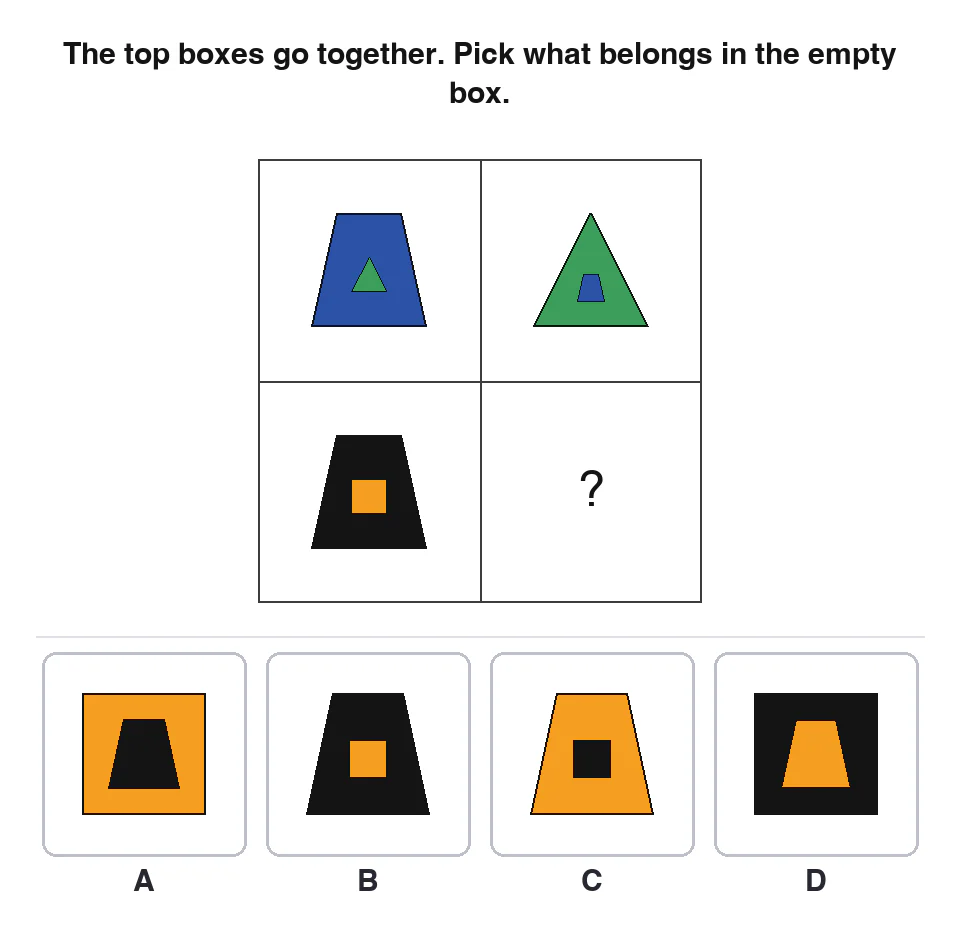
Nonverbal: Figure Matrices (1st grade)
The top boxes go together. Pick what belongs in the empty box.
Show answer
Answer: A. The inside and outside shapes trade places, and each keeps its color. The orange square goes outside, the black trapezoid inside.
See all nine in the CogAT question types guide.
The CogAT Screening Form
Many districts start with the Screening Form, a shorter version that uses the first subtest of each battery: Verbal (or Picture) Analogies, Number Analogies and Figure Matrices. It produces a composite score only. Students who reach the district's cut-off may then take the remaining six subtests, called the post-screener, to complete the full CogAT.
Paper vs online CogAT
Schools can give the CogAT on paper with bubble answer sheets or online through Riverside's testing platform. The questions, timing and scores are equivalent. On the online version, primary-level questions are read aloud through headphones. If your child has never used a computer for a test, a little practice clicking through questions on a tablet or laptop can help.
Scoring at a glance
Raw scores are converted into a Universal Scale Score, then into age- and grade-based scores: the Standard Age Score (average 100), percentile ranks and stanines. There is no penalty for wrong answers, so children should answer every question. Full details in CogAT scores explained.
Frequently asked questions
How many sections are on the CogAT?
Three batteries (Verbal, Quantitative, Nonverbal), each with three subtests, for nine subtests in total.
Is the CogAT timed?
At Levels 9 and above each subtest has a 10-minute limit. Levels 5/6 to 8 are paced by the person giving the test.
Can you skip questions on the CogAT?
Students can move on from a hard question and come back if time allows within the same subtest. Because there is no penalty for wrong answers, every question should get an answer.
Is the CogAT multiple choice?
Yes. Every question is multiple choice, with pictures, words or numbers as the options depending on the level and subtest.